-
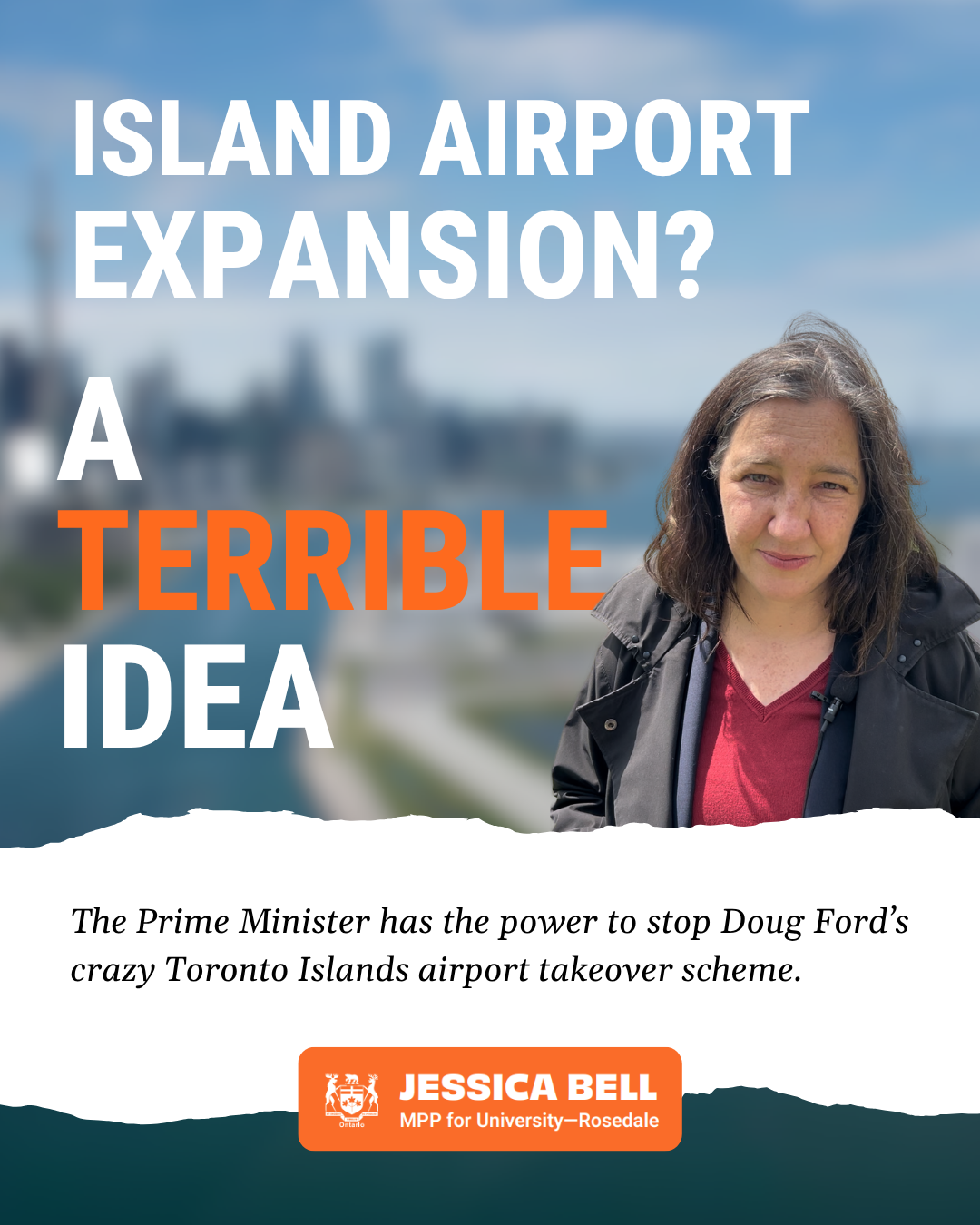
Why Expanding the Toronto Island Airport Is a Terrible Idea
This week, I attended a town hall on the Conservative government’s threat to expand the Toronto Island Airport and permit larger jets.
More than 200 people packed the gym at the new community centre at Queens Quay East. There was a feeling of deep anger toward the Doug Ford Conservative government for, once again, messing with Toronto’s waterfront; and betrayal by the Carney Federal Government for failing to stop it.
-
I oppose allowing jets at the Toronto Island Airport.
Until I attended this meeting, however, I did not fully grasp just how breathtakingly stupid this expansion would be.
-
Expanding the airport to accommodate jets is not a minor tweak—it is a massive industrial project.
The runway would have to be extended by 336 metres. Approach lighting would need to be installed up to 750 metres beyond the runway in both directions. Wall-like jet blast deflectors would be required to prevent boats from being overturned by engine thrust. Beaches on Toronto Island would be reduced.
Much of what we know has been uncovered by citizen’s group Waterfront for All through freedom‑of‑information requests—laws the government is about to weaken. Even with these disclosures, there is still a great deal we don’t know. What we do know is the expansion will be significant, permanent, and deeply damaging to our quality of life.
-
The health impacts are real.
Toby Heaps, a parent of three who lives near the airport, spoke about his concerns for his children’s health. He has every reason to worry.
An air‑quality study conducted by the Bathurst Quay Residents Association and the University of Toronto found that levels of ultrafine particles near the airport regularly exceed World Health Organization guidelines. These levels spike dramatically during plane takeoffs and landings.
These ultrafine particles—about a thousand times thinner than a human hair—can penetrate deep into the lungs and have been linked to serious health outcomes, including lung cancer.
With the Gardiner Expressway to the north and the gas-plant to the east, downtown residents already face significant environmental burdens. Adding jet traffic into this mix should alarm everyone who lives near the downtown core.
Expect noise you can’t ignore. Every Labour Day weekend, Torontonians collectively grit their teeth while the International Air Show roars overhead. We tolerate it because it lasts a few days.
-
Now imagine that noise every single day of the year.
Picture sitting on your balcony on a summer evening, having dinner with friends—only to have your conversation drowned out by a descending jet every two minutes.
The owner of Billy Bishop Airport loves to talk about “whisper jets.” But anyone who has ever stood at the end of a runway knows there is no such thing as a quiet jet.
John Nishikawa of the Toronto Ornithological Club raised another serious issue: birds.
Just this week, he observed 1,100 tundra swans, each weighing about 20 pounds, flying through the Toronto Spit—immediately east of the airport. There are roughly 170,000 birds in and around Toronto Island.
Bird strikes are a well‑documented aviation risk, particularly with jet engines. Transport Canada recommends there be no waterfoul refuge 3.2kms from an airport. What is the plan to keep birds away? Drones? Sound canons? Habitat destruction? We don’t know.
-
This all leads to a fundamental question: who is the waterfront for?
Years ago, the city made a choice to prioritize people over industry. That’s why 800 hectares at the mouth of the Don River are being redeveloped for housing. It’s why the waterfront has become one of the densest residential neighbourhoods in North America.
Encouraging people to part with their life savings and buy homes here only to strip away everything that makes the waterfront livable feels like a profound betrayal.
Toronto urbanist Jane Jacobs said that you must win a fight three times. The influential No Jets TO campaign has already beaten back attempts to expand the airport in 2003 and 2015. Now it’s time to win again.
There are many opportunities to push for change.
The upcoming Scarborough Southwest byelection, which must be held before September, provides a clear opportunity to send a message to Doug Ford.
Any expansion requires federal approval.
-
Downtown Toronto Liberal MPs must hear—loudly and consistently—from constituents who expect them to quash it.
Influential stakeholders with access to the provincial government should be encouraged to pick up the phone. Major developers, many with Conservative ties, stand to lose real money if the waterfront becomes a less desirable place to live.
The waterfront belongs to the people who live there, work there, and visit—not to big jets.
Let’s protect it.

Jessica Bell
MPP, University-Rosedale