
Dear neighbour,
The legislative session ended yesterday, and what a whirlwind seven weeks it has been.
It was a session marred by some terrible omnibus bills, surging job losses, and troubling democratic backsliding.
Bill 60 made it easier for big landlords to evict tenants. Bill 33 gave the Minister of Education power to take over school boards and remove school board trustees.
The Fall Economic Statement has set us on a path of more cuts to education and healthcare, and a continuation of the failed economic experiment of giving handouts with no strings attached (none that we can see anyway) to big companies.
In a disturbing and undemocratic first, the government has now made it standard practice for bills to skip committee, which means the public can no longer address issues about the bill and no MPP can introduce amendments.
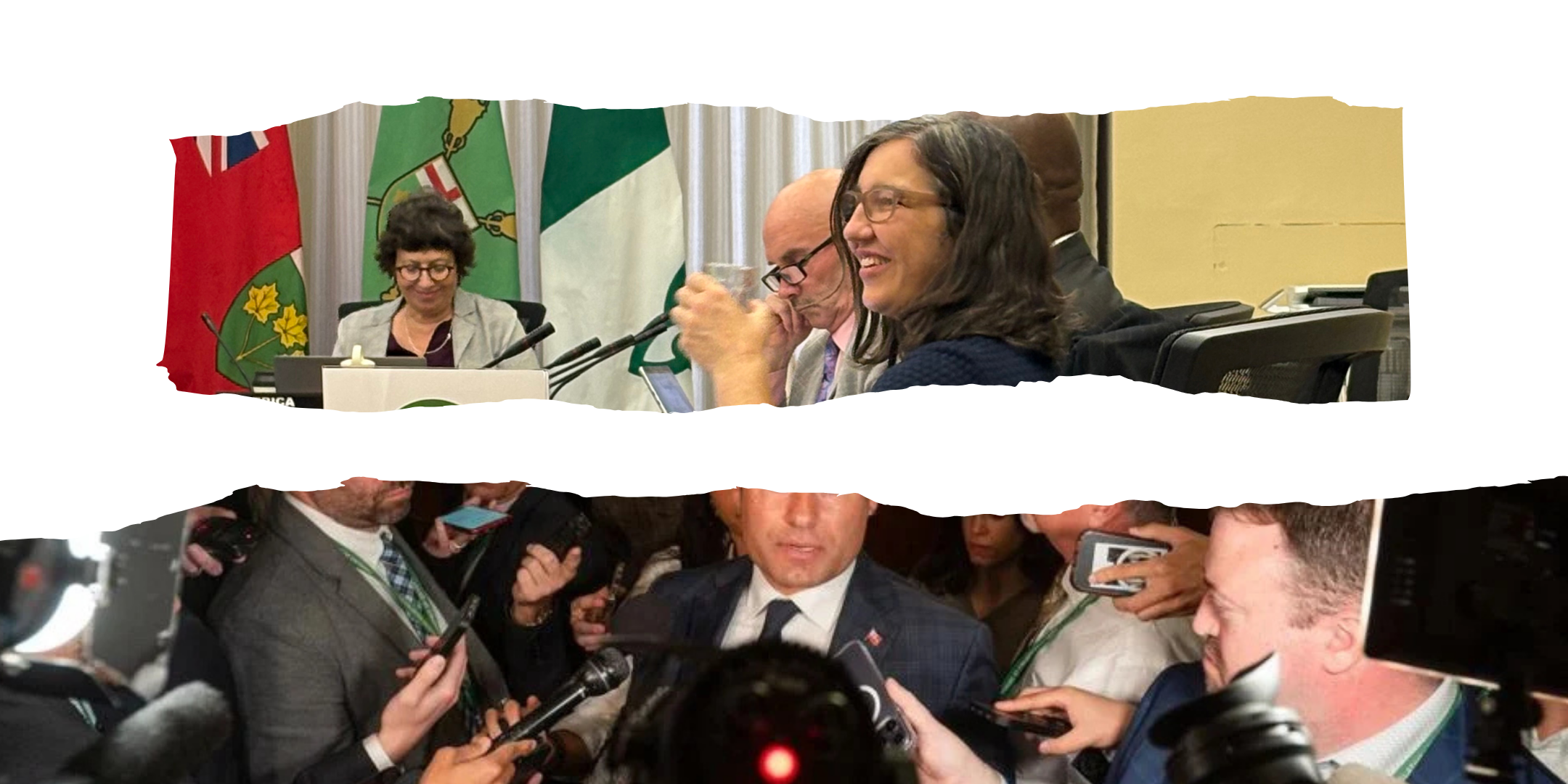
What I will remember most about this session, however, is the government’s mishandling of the Skills Development Fund.
The Minister of Labour David Picinni - and his predecessor Monte McNaughton - played favorites in their handing out of $2.5 billion in funding to companies and unions to train unemployed workers.
Companies that donated thousands to the Conservative party were given millions of dollars in funding over far more qualified applications. Strip clubs. The Ford family dentist. A company under investigation by the OPP.
The Conservatives have ruled that legislators will be in recess until March 23, which is a ridiculously long winter break.
One of the many purposes of the legislative session is to hold the government to account, and improve their work.
Opposition MPPs do this through Question Period, debating bills in the legislature, and asking Ministers questions in committee, among other ways.
Since we will not have access to these tools until March, we’re going to have to be creative and tenacious. And we will.
C can be for corruption as well.
Sincerely,

Jessica Bell
MPP, University-Rosedale
In this newsletter:
- U.S. company buys Ontario’s largest diagnostic testing lab
- What’s in the Conservative’s latest tough on crime bill?
- Bill 46 puts our forests at risk
- NDP releases 121 recommendations to end Ontario’s domestic violence crisis
- Townhall reportback: Is Ontario still a Democracy?
- We’re hiring! Join our Team
- Holiday Closure
U.S. company buys Ontario’s largest diagnostic testing lab
On Tuesday, December 9, my colleagues MPP France Gélinas and MPP Jamie West pressed the Ford government on the sale of LifeLabs to U.S.-based Quest Diagnostics and the service changes already being reported in Northern Ontario.
LifeLabs has moved to close its Sudbury laboratory and ship samples from Timmins, North Bay, Algoma, Hearst, and Sudbury to Toronto for processing. When highways close or delays pile up, samples can expire, forcing patients to repeat critical tests.
Forty medical laboratory technologists in Sudbury are losing their jobs. Local same-day and rapid testing capacity is disappearing. This will deepen health inequities in Northern Ontario, especially for elderly, rural, and low-income patients who already face barriers to care.
Why am I, a downtown Toronto politician, concerned about the sale of Life Labs?
I’m concerned because the sale of Life Labs to Quest, a U.S. company that’s traded on the stock exchange, is exactly what happens when the Ontario government permits for-profit companies to provide health care to Ontarians.
Life Labs provides testing across Ontario, including Toronto. I think we can expect staff cuts. I think we can expect more fees.
The Minister of Health just announced on Monday, December 8, that four new for-profit clinics have been given permission to perform orthopedic surgeries. They include Academic Orthopedic Surgical Associates of Ottawa, Windsor Orthopedic Surgical Centre, Schroeder Ambulatory Centre in Richmond Hill, and OV Surgical Centre, right here in Yorkville.
Based on what we know is happening with for-profit cataract surgery, we can likely expect patients to have to pay for some services, and that the waitlist for surgery will not be managed solely on need. Maybe healthier patients will jump to the front of the queue because they’re quicker to treat, or maybe those who can pay will be seen ahead of those who can’t afford the extra care.
And what is stopping these clinics from being sold to a Bay St or Wall St firm? We’re investigating to find out.
What’s in the Conservative’s latest tough on crime bill?
On Tuesday and Thursday this week Bill 75, the Keeping Criminals Behind Bars Act, was debated at Second Reading. Debate on this bill will resume after the legislature returns on March 23.
Bill 75 is a big omnibus bill, and while it has a few schedules that are sensible, the bill doesn’t include good policies that will reduce crime.
Here’s what Bill 75 proposes:
- Brings in “cash bail,” requiring people or their families to pay money up front to get out on bail. That risks creating a two-tier justice system where freedom depends on how much money you have.
- Expands reliance on sureties, pushing more responsibility onto friends, parents, and grandparents to supervise someone on bail — a role most people aren’t trained for and shouldn’t be forced into.
- Bans breeding cats and dogs for research in Ontario, and adds restrictions and penalties around certain invasive animal research.
- Toughens traffic penalties, including longer licence suspensions and higher fines for dangerous driving offences.
Ontario’s bail system is overwhelmed because of court backlogs, staffing shortages, and limited access to legal representation.
We are calling for a more comprehensive public safety strategy that focuses on measurable investments such as:
- Hiring additional judges, prosecutors, and court staff to reduce bail and trial backlogs.
- Expanding access to legal aid so people can secure timely legal representation and comply with bail conditions.
- Doubling the ODSP and OW rates to help get people out of deep poverty.
- Investing in at least 30 000 supportive housing to reduce homelessness.
If you have thoughts on this bill, I want to hear from you. Reach out to my office at [email protected] or by hitting the button below.
Bill 46 puts our forests at risk

On Thursday, December 11, the government passed Bill 46, the Protect Ontario Through Cutting Red Tape Act.
Like many of this government's omnibus bills, Bill 46 folds together dozens of changes across multiple ministries. Some of these changes are modest. For example, updates to the Consumer Protection Act so people can ask for rewards points to be credited back if they were improperly cancelled or expired. Or allowing designated alcohol-use areas in some provincial parks starting in 2026.
Some of the bill’s schedules are troubling. The most concerning schedule is a change to the Crown Forest Sustainability Act that lets the Minister exempt certain industrial activities (like mining or aggregate projects) from normal forest management rules around the clearing of forests on Crown land.
In other words, if a mining, road, or quarry project requires the clearing of forests on Crown land to proceed, the Minister can allow that to happen without the usual forest management safeguards. The bill says the Minister is supposed to consider things like impacts on wildlife, water, soil, and Aboriginal and Treaty rights, but the details will be set later in regulation and are ultimately at the Minister’s discretion.
Forestry union, Unifor, has flagged that Bill 75 creates one set of obligations for traditional forestry companies, and another looser set of standards for mines, roads, quarries and other industrial projects that clear forests. Bill 75 is a problem for forest protection, wildlife, water quality, and Indigenous rights.
NDP releases 121 recommendations to end Ontario’s domestic violence crisis
On Tuesday, December 9, my colleagues MPP Kristyn Wong-Tam, MPP Lisa Gretzky, and MPP Alexa Gilmour released the Ontario NDP’s dissenting report on intimate partner violence, with 121 concrete recommendations to end violence and stop the rise in femicide we’re seeing across the province.
The report follows a lengthy committee study process created and controlled by the Ford government in response to the NDP’s Bill 173, the Intimate Partner Violence Epidemic Act, 2024, reintroduced this year as Bill 55. The NDP committee members cooperated with the three-phase process while advocating that the government enact the recommendations of countless high-quality reports.
When the government’s final report was released, it was authored by a single government MPP rather than by legislative research staff, which is a departure from standard practice. Many key findings and recommendations raised consistently by survivors, frontline workers, and previous inquiries were not included. Several sources listed in the references did not exist. For these reasons, NDP members submitted a formal dissenting report to document the evidence heard and the actions needed.
Now that both reports are published, the priority is implementation. Our dissenting report calls for, among other steps:
- Declare IPV an epidemic in Ontario to compel urgent, emergency-level government action, including inter-ministerial coordination, resource allocation, transparency, and accountability.
- Move to annualized, inflation-indexed funding for survivor support services (not project-by-project).
- Invest in housing options including purpose-built housing for families, supportive housing, and adjustments to the Canada-Ontario Housing Benefit (COHB)
- Restore previous budget cuts and increase funding to Legal Aid Ontario to ensure greater access to survivors.
- Create a centralized, multi-ministry working group to coordinate response across health, justice, housing, education, and social services.
You can read the full report here.
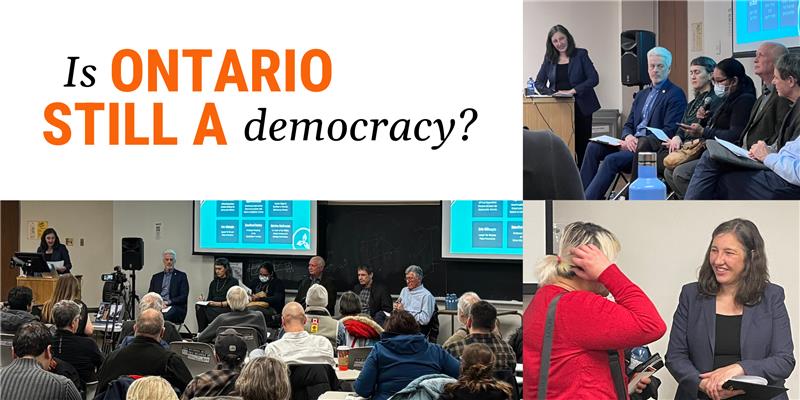
Is Ontario still a Democracy? On Monday, December 8, I tackled this question alongside MPP Chris Glover (Spadina Fort-York) - the Shadow Minister for Democratic Reform, at a town hall at the University of Toronto.
We’re hiring! Join our team
We are hiring a permanent full-time Constituency Assistant, with a focus on casework, to work in our University–Rosedale office.
We’re looking for someone who has a background in social work or case work, great with people, and skilled at organizing events, writing and social media.
You’ll help constituents, strengthen our presence in the community, and support outreach and communications for the riding.
Information about the job and how to apply in the button below.
Please include a brief cover letter and resume.
We’re committed to equity and welcome applicants from diverse backgrounds. Accommodations available on request.
Holiday Closure
Happy holidays to you and your loved ones. Please note our constituency office will be closed on December 24 and reopening on Monday January 5.