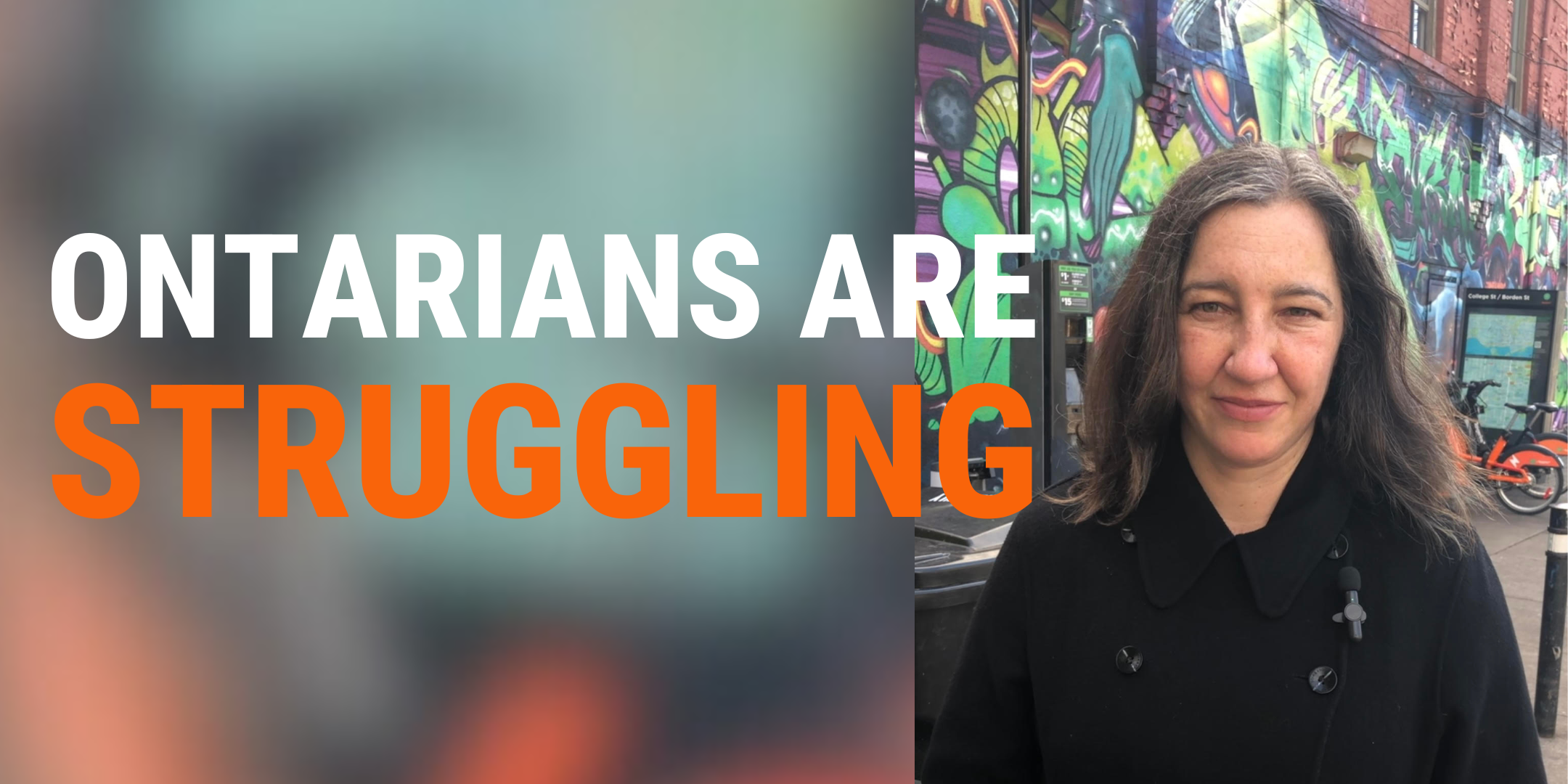
Last Thursday morning, myself, NDP Leader Marit Stiles and MPP Chris Glover (Spadina-Fort York) visited the Fort York Food Bank on College St.
The Fort York Food Bank is now one of the busiest food banks in the country. We were told by staff that workers are now some of the most frequent visitors of their food bank.
We visited the food bank on the morning of the government’s release of the Fall Economic Statement (FES) to send a message that the government’s mini-budget should also care about the Ontarians who are struggling the most. Did it? Let’s take a look.
Here is what you should know about the Fall Economic Statement:
-
Healthcare
Health care spending growth will be slashed to less than 1%, far lower than inflation and the increased demand we're facing as our population ages. This funding plan is a recipe for emergency room closures, longer wait times for surgeries, burned-out staff, and declining health care quality.
-
Education
The education budget is growing at a rate lower than inflation and population growth, which means, can you believe it, more school cuts are coming. Post-secondary education is facing cuts of more than $1.4 billion over the next four years, with current spending levels already $1 billion lower than in 2024. With spots shrinking and campuses and departments closing, I expect high school students will be playing the Hunger Games to get into their desired college or university.
-
Housing
The government has thrown in the towel on fixing the housing crisis. The FES estimates there will be just 64,300 homes built this year, the lowest housing starts in a decade. The mini-budget made no commitment to build more affordable housing, address homelessness, or stabilize rent.
-
Environment
The FES repeals Ontario’s requirement to track and report on its plan to address climate change and reduce greenhouse gas emissions. This is the latest move by this government to dismantle its climate change plan. The Auditor General has slammed the government for falling short on meeting its target of reducing emissions by 30% below 2005 levels by 2030, and for refusing to come up with any target at all post-2030. The Conservatives do not give a damn about addressing climate change.
The government has also shown they are not serious about the environment, by choosing to consolidate existing conservation agencies into a sprawling, umbrella-style organization: the Ontario Provincial Conservation Agency. This will mean skills and understanding of local conservation areas, habitats and species will be lost and less resources will be available, which will make it even harder for Ontario to safeguard natural spaces.
-
Democracy
The government is continuing their attack on democracy. Folded into the FES is a move to get rid of fixed election dates, and the maximum donation to political parties will be increased from $3,400 to $5,000. Registered third parties - like pressure and lobby groups - and political parties will also have no limits at all on their spending in the time before an election. Rules designed to ensure fairness and predictability for our elections have been scrapped, and these changes give the governing party the sole advantage of choosing when Ontarians go to the polls. This is the latest step in a dangerous and troubling pattern that has emerged, where the government is seemingly focused on making our elections about money and lobbyists, not people and their votes.
-
Exhibition Place at risk
The “Ontario Place site”, where demolition and redevelopment has been allowed with almost no restriction on Toronto's waterfront, could get even bigger. Legal changes for five more pieces of land are included in the FES by the government, including nearly all of the city-owned CNE lands, and the lands owned at Exhibition Place by the City of Toronto, allowing them to be taken over by the province. The government has also axed the requirement to negotiate with the City of Toronto before claiming land for use, occupation, or modification - potentially with no compensation for the city.
- Ownership registry
In the FES, the government announced that they would finally move forward with an Ontario ownership registry, scheduled to be in place by 2027. Instead of a murky world of anonymous numbered corporations, a beneficial ownership registry would allow Ontarians to easily search to find who owns what. Ontario has been slow to act on this, requiring only that corporations provide information to the government but restricting public access to this data.
This announcement is a good next step for anti-corruption advocates, although much delayed. Other provinces, including Quebec and British Columbia have already moved further on this issue. It's possible that recent moves by British Columbia have forced Ontario’s hand.
-
Economy
The economy is spluttering. Unemployment is at 7.8 percent, the highest level in a generation. The Conservatives subscribe to the long-debunked trickle down economic theory, where corporations will supposedly hire more workers and invest if they’re given tax cuts or government funding. The government announced that more tax cuts are coming in the next budget. They also re-announced their secretive $5 billion dollar Protect Ontario Fund, which gives out loans to trade-impacted businesses, including U.S. companies.
We need a made-in-Ontario jobs plan that gets people employed, and makes our province more sustainable and self-reliant. Any business loan should come with an iron-clad agreement to not lay off workers, move offshore, or hike executive compensation.
Ontario’s Buy Ontario policy should be stronger so government investment in public infrastructure and services goes to Ontario or Canadian companies first. We need far more investment in public services, housing construction, hospitals, schools, municipalities, green initiatives, and public transit to create and protect Ontario jobs.
Call it Ontario’s New Deal, but for the 21st century.
Jessica Bell
MPP, University-Rosedale