

Dear neighbour,
I expect Toronto and Ontario to be a place where renters can afford the rent, live well, and save.
That’s not the case today. Rent is too high, many tenants are dealing with Above Guideline Rent Increases (AGIs), and too often people are left to navigate the Landlord and Tenant Board on their own. I regularly hear from tenants who are worried about affordability, maintenance issues, and protecting their rights.
That is why I am hosting a Renters Action Night on June 22 from 6:00 p.m. to 8:30 p.m. at Knox Presbyterian Church (630 Spadina Avenue).
This event is an opportunity to meet other renters, learn practical skills, and talk and plan for action with tenant organizers, legal experts, and housing advocates.
Workshops will include:
- How to fight Above Guideline Rent Increases (AGIs)
- Preparing for an LTB hearing and what to expect from the process
- How to organize a tenant association in your building
I also want to hear directly from you. Come share your experiences as a renter, the challenges you are facing, and the solutions you would like to see. Your feedback will help shape my work at Queen's Park this fall.
Food provided.
To RSVP click here or the button below.
I look forward to seeing you there.
Sincerely,

Jessica Bell
MPP, University-Rosedale
In this newsletter:
- Join our Bay St Area Community Townhall - Tonight - June 9
- Heydon Park is built for its students. It needs to stay open.
- New air conditioning rules for renters start July 1
- Ford shuts down Legislature as Ontario sees steepest job losses since 2009
- Ontario’s terrible climate plan should inspire action
- Have your say on the future of Billy Bishop airport
- Queen’s Park North report goes to committee June 10
- A summer message from elected trustee Deborah Williams
- Heat pumps + Condos webinar
- Seniors Survey
Join our Bay St Area Community Townhall - Tonight - June 9
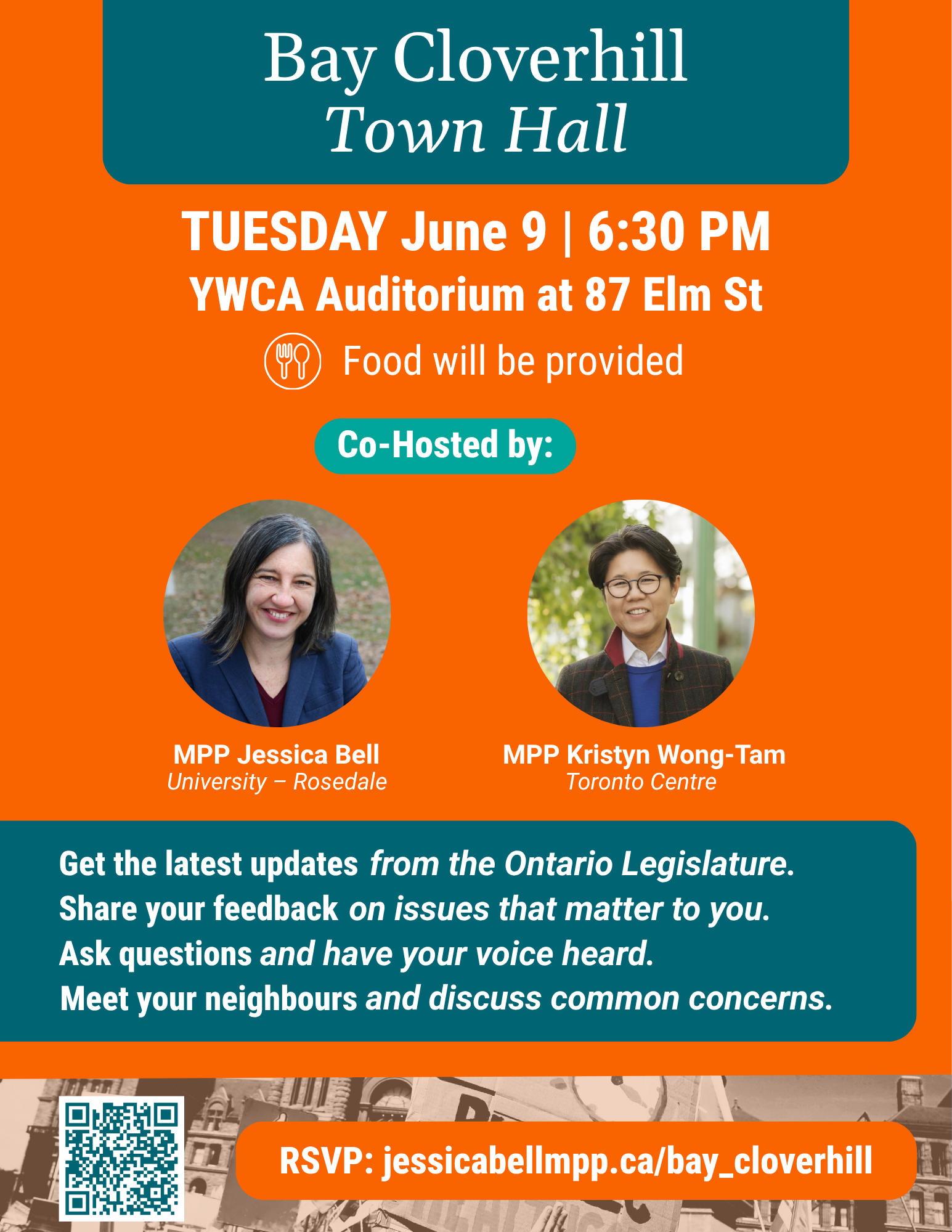
Join myself, MPP Kristyn Wong-Tam, community groups, and residents for a Community Townhall in the Bay St Cloverhill neighbourhood.
We’ll share provincial updates, answer questions, hear your feedback, and talk about the issues affecting our community.
Food provided
When: Tuesday, June 9 at 6:30 PM
Where: YWCA Auditorium at 87 Elm Street
You can RSVP here or in the button below.
Heydon Park is built for its students. It needs to stay open.
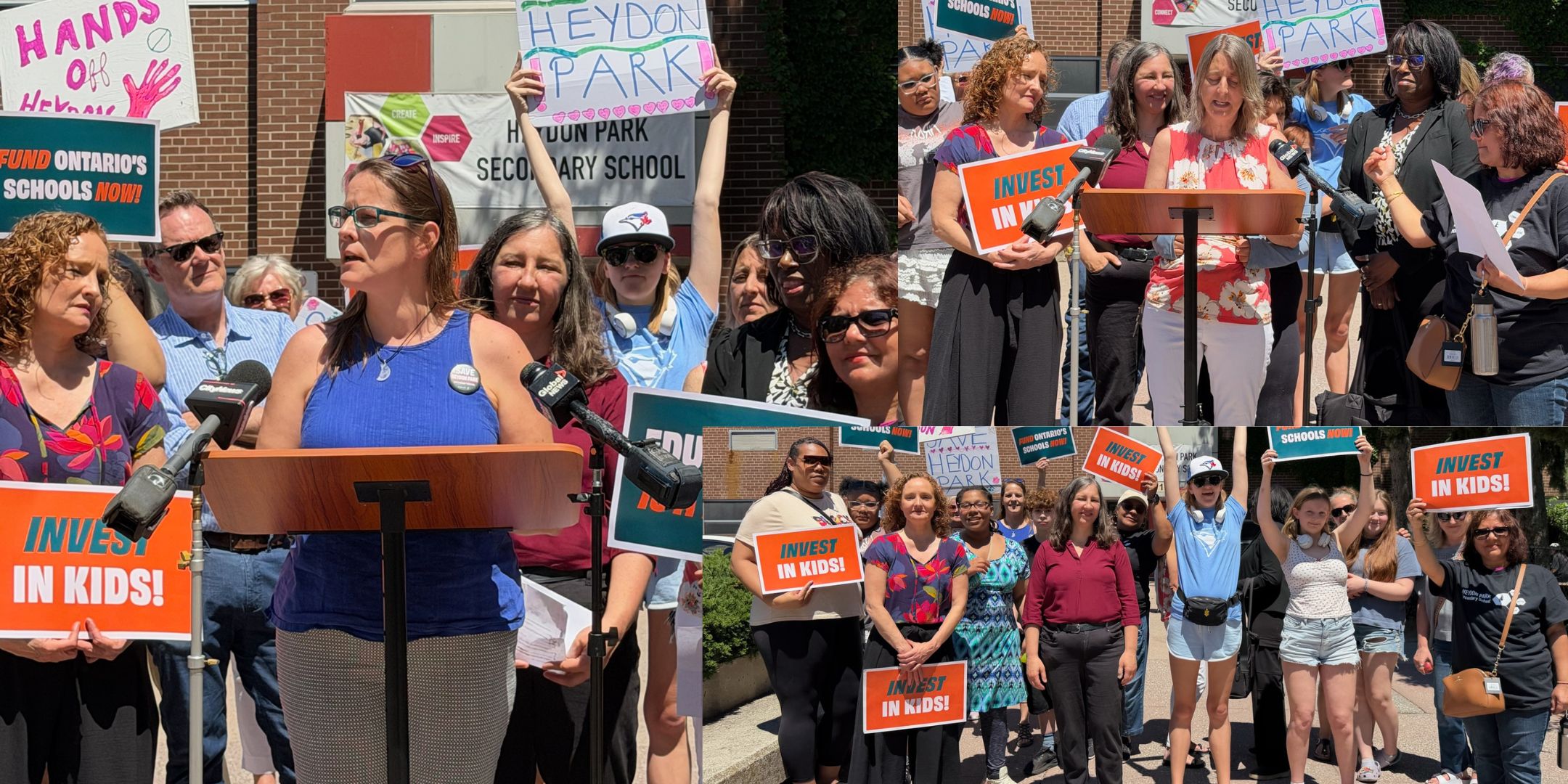
On Monday, June 8, I held a press conference with MPP Alexa Gilmour, elected trustee Deborah Williams, parents, students, teachers, and advocates calling for Heydon Park Secondary School to be protected.
Heydon Park is a very special school. It is loved.
For 100 years, Heydon Park has provided a safe, welcoming, and supportive education for girls, trans and non-binary students with disabilities and significant learning and mental-health needs who require stability, routine, and the right support to reach their full potential.
Now families are being kept in the dark about what comes next.
First, Grade 9 enrollment was cut. Then Grade 10 enrollment was cut. Now families have learned that Orde Street Public School students will be temporarily moved into the Heydon Park building, forcing the Heydon Park school community to leave.
Where will Heydon Park students be moved to? No one knows.
That uncertainty is causing enormous stress for families. Parents are also worried this is not just a temporary relocation. They fear it is one more step toward closing Heydon Park.
Parents like Paulete made very compelling points about how Heydon Park is not just a building. It is a school specifically designed around the needs of its students.
The building includes an industrial kitchen where students take shifts and learn how to prepare food. It has cosmetology training. It has biology labs set up for high school students. These spaces support the life skills, hands-on learning, and specialized programming that Heydon Park students rely on.
An elementary school has very different needs. Younger children need different classrooms, equipment, supervision, outdoor space, and programming. Moving elementary students into a high school space built around specialized secondary programming just seems like poor planning.
Parents also spoke about safety. Maja explained that students at Heydon Park are some of the most vulnerable in the education system. Many travel across the city because they struggled in mainstream settings. Some experienced severe bullying, anxiety, sensory overwhelm, or stopped going to school altogether before finding a safe and supportive place at Heydon Park.
Grace spoke about her daughter Sammy, who is in Grade 10 and should have several more years at Heydon Park to learn, thrive, and work toward a certificate or diploma. She said Sammy has complex educational, physical, and emotional needs and would not receive the same support at another TDSB school.
This threat to Heydon Park is happening in the context of deep Conservative cuts to public education. We have seen cuts to special education, staff layoffs at the TDSB, bigger class sizes, and now the threat of school closures.
We want two things.
Heydon Park is a special school. It needs to be protected. It needs to remain open.
Every child in Ontario should be able to learn in a safe and welcoming public school so they can reach their full potential. That is only going to happen if we reverse the Conservative cuts and invest in our kids instead.
New air conditioning rules for renters start July 1

Starting July 1, changes to Ontario’s Residential Tenancies Act will give tenants the right to install and use a window or portable air conditioner when their landlord does not provide air conditioning.
Tenants must notify their landlord in writing before installing the unit. The air conditioner must be installed safely and securely, and not damage the rental unit or building.
If the landlord pays for electricity, they may be able to increase the rent to recover the actual or reasonably estimated cost of running the air conditioner. That increase must be removed when the air conditioner is removed or not being used seasonally.
The city of Toronto has also introduced new indoor temperature rules. As of June 1, if a landlord already provides air conditioning, they must operate it between June 1 and September 30 and keep indoor temperatures at or below 26 C. Apartment buildings in the RentSafeTO program that do not provide cooling but have an indoor amenity space must ensure this space stays at or below 26°C from June 1 to September 30.
These changes matter, but they do not go far enough. Renters should not have to choose between unsafe heat and higher rent.
That is why we need a provincial legal maximum temperature for all rental units, along with protections that allow tenants to install air conditioning without added charges or rent hikes.
I support my colleague MPP Catherine McKenney’s Hot Days, Cool Homes Act, which would make cooling a vital service under the Residential Tenancies Act and require rental units to be kept at a maximum of 26 C between June 1 and September 30.
But we cannot solve this problem with one air conditioner at a time. We also need to improve the Building Code so new buildings are more energy efficient, invest in retrofits for existing buildings, and keep our cities cooler by planting more trees and expanding shade.
Sign our petition for a provincial maximum heat law today.
Ford shuts down Legislature as Ontario sees steepest job losses since 2009
On Wednesday, June 3, the Financial Accountability office released its latest Economic Monitor, covering the latest trends in the Ontario economy from October 2025 to March 2026.
The report showed Ontario’s economy is weakening and workers are paying the price.
Ontario lost 52,900 jobs in the first quarter of 2026, the steepest quarterly job loss since early 2009, excluding the pandemic. Nearly half of those losses were in manufacturing.
Job losses affected every major age group. Youth employment fell by 33, 400 jobs, core-age employment fell by 13, 100 jobs, and employment for workers 55 and older fell by 6,400 jobs.
Long-term unemployment now accounts for 28.2% of all unemployment in Ontario, the highest rate since 1996, excluding the pandemic.
At the same time, people are still being squeezed by rising costs. Food inflation is now at 6.8% and the FAO estimates higher gasoline and diesel prices could add $648 in fuel costs for the average Ontario household in 2026.
With numbers this bad, it is no wonder the Premier shut the Legislature early and gave himself a five-month summer vacation.
Instead of private jets and airport expansions, Doug Ford should be investing in public infrastructure and public services to keep and create good jobs and lower costs, along with a strong Buy Ontario plan so government contracts go to Ontario and Canadians businesses wherever possible.
Ontario’s terrible climate plan should inspire action
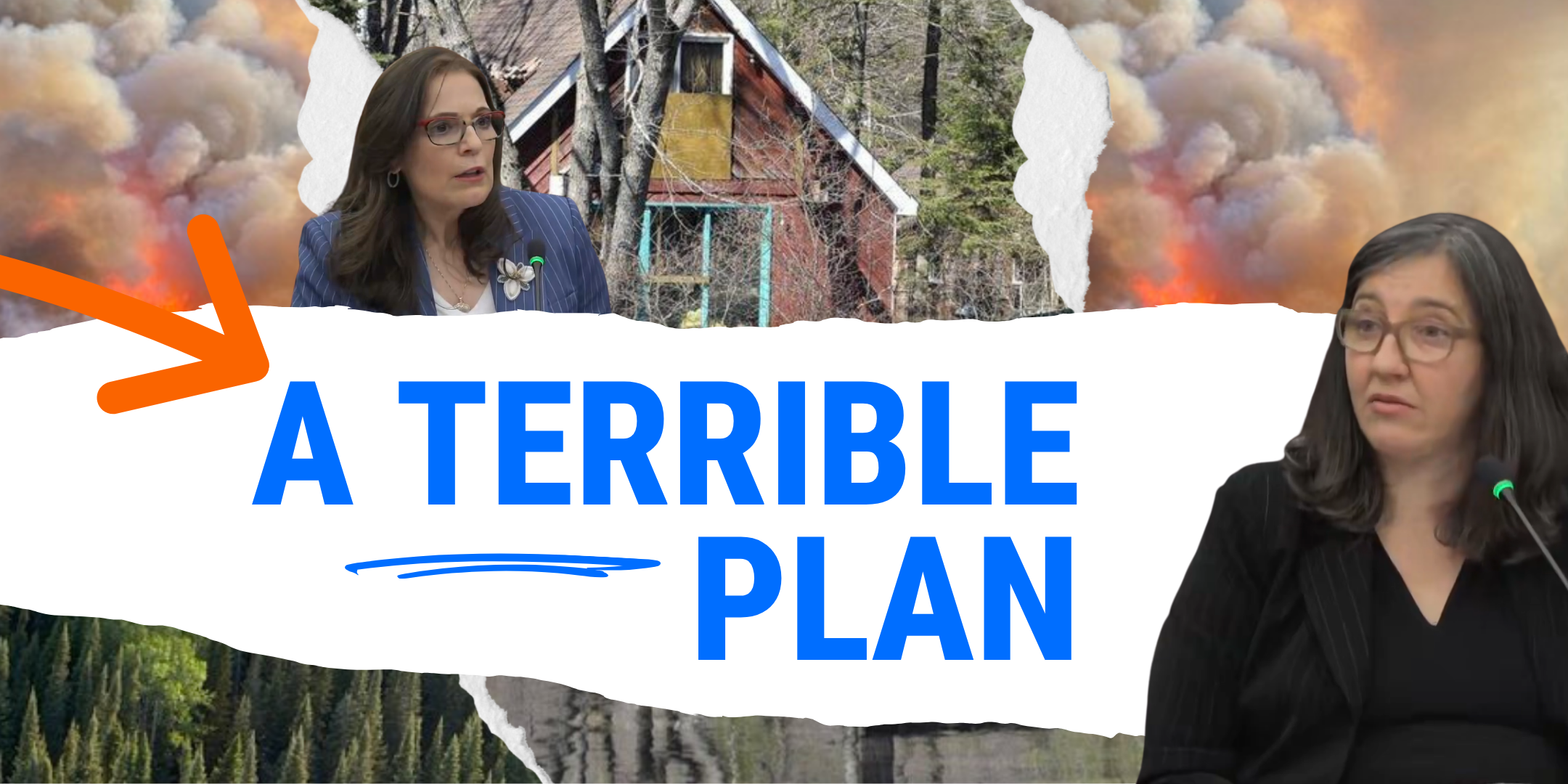
In April, I participated in hearings to assess the Conservative government’s progress on its climate action plan. I left feeling betrayed, and undeterred.
In her 2025 report, Auditor General Shelley Spence concluded that Ontario is not on track to meet its own emissions targets. The province is projected to reduce emissions by only 22% below 2005 levels by 2030, well short of the government’s 30% goal.
The Premier has made a career of hating the environment. With his “axe the tax” mantra, he hammered for years on the misleading message that a carbon tax is why everything is so expensive.
From ending the cap-and-trade program, to cancelling wind energy contracts, to rewriting Ontario’s planning rules to allow carbon-intensive low-density sprawl, the Conservatives have been committed to gutting environmental protections.
After 2030, Ontario is flying in the dark. Officials in the hearing confirmed the government has no public targets, plan, or tracking after 2030.
There is also no comprehensive adaptation plan to prepare Ontario for the climate impacts already here, including extreme heat, dangerous wildfires, flooding, threats to our food supply, and growing pressure on emergency responders and hospitals.
Reducing emissions and preparing for a hotter, more extreme climate is the only morally, socially, and economically sound choice. The consequences of ignoring reality will be felt in our standard of living, our health, and our economy.
An NDP government would fully accept the Auditor General’s recommendations to develop, publish, implement and track a sound climate action to reduce our emissions, along with a comprehensive plan to ready our towns, cities, key economic sectors, health care system, and more.
The solutions are all around us. Other countries and cities are moving forward with serious plans to reduce emissions and prepare for extreme weather. Ontario should be doing the same.
You can read my full report here.
Have your say on the future of Billy Bishop Airport

After weeks of relentless pressure from the public, the Federal government has decided to hold a public consultation on the future of Billy Bishop Toronto City Airport.
This consultation comes weeks after the Ford government passed legislation to take over City-owned airport lands, raising serious questions about the future of the airport, the Toronto Islands, and our waterfront.
The federal government is asking residents, travellers, businesses, waterfront users, community groups, and others to share their views on issues including noise, environmental impacts, housing, transportation, access, urban planning, economic development, and community benefits.
I have two issues with this consultation. First, there’s no public information on what the airport is going to be, so how can you have meaningful feedback if people don’t have the facts. Share the facts.
And second, this consultation is clearly being carefully managed. You can participate by mail or by filling in an online survey here to Transport Canada. I think there should be public meetings.
Queen’s Park North report goes to committee June 10
Toronto City staff have released a new report on the proposed Queen’s Park North revitalization project, supported by a $50 million private donation from the Weston Foundation.
The report recommends that City Council approve the updated concept plan as the basis for the detailed design, procurement, and delivery of the project. It also recommends creating a detailed design working group and moving ahead with agreements for the project.
The updated plan includes changes related to tree protection, heritage conservation, the proposed café and washrooms, the learning forest, and the scale of new park features.
Read the concept plan update report here.
The report will be considered by the Infrastructure and Environment Committee on June 10. Learn how to submit feedback, written comments, or request to speak at committee here.
Summer message from elected trustee Deborah Williams
I am thrilled to pass along the message below from Deborah Williams, the democratically elected TDSB trustee for Ward 10 - University-Rosedale and Toronto Centre.
As we welcome summer’s warmth and light, let’s celebrate the strength, creativity, and resilience our students and school communities have shown this year. Despite the challenges, together we’ve built spaces rooted in belonging, well‑being, and high expectations. As your elected Trustee, I remain steadfast in my commitment to championing equity, inclusion, and opportunity for every student.
Bill 101 received royal assent and became law on May 7, 2026. Bill 101, Putting Student Achievement First Act, 2026 is a significant restructurings of Ontario’s education system. It will directly affect how families and communities are represented and how decisions are made in our schools. For English-language boards, Bill 101 changes labour relations with a new bargaining structure. The Council of Ontario Directors of Education (CODE) becomes the central employer bargaining agency. Ontario Public School Boards’ Association (OPSBA) and Ontario Catholic School Trustees’ Association (OCSTA) lose their long-standing roles in central bargaining. Regulations stemming from Bill 101 were recently filed concerning the School Boards Collective Bargaining Act. This could affect how labour negotiations unfold, including strikes or job actions. #CutsHutKids #FundOurSchools
Parent and community advocacy to support publicly funded education in Ontario is growing. See resources and ways to add your voice:
CALL TO ACTION: Call and Email Premier Doug Ford at 416-325-1941, [email protected] & Education Minister Paul Calandra at 416-325-2600, [email protected] to DEMAND they:
- Fund Our Schools!
- Fund education to match inflation
- Fully fund special education and student supports
Thank you for supporting our schools and communities. Together, we’re building a future rooted in care, inclusion, and hope.
As we near the end of the 2025–2026 school year, my heartfelt best wishes to you. To our graduates, congratulations on this milestone. To every student, family, educator, and staff member, thank you for your dedication and heart. May this summer bring rest, joy, and renewal as we look ahead to another school year of possibility.
Sincerely,
Deborah Williams
elected Trustee, TDSB Ward 10 University-Rosedale and Toronto Centre (*June 27, 2025 TDSB under supervision of the Ministry of Education)
Heat pumps + Condos webinar

Getting your condo board to act on sustainability can be one of the hardest parts of condo living.
Toronto Home Energy Network and Sustainable Buildings Canada are hosting a webinar for Toronto condo owners who want to help their building reduce emissions and explore switching to heat pumps. Participants will leave with practical next steps and an action plan for how to bring the conversation to their condo board.
Monday, June 29
6:30–7:30 pm
Online
See more and register here
Survey on the needs of older adults
A group of local volunteers is gathering feedback from older adults who live between Davenport Road, Dundas Street West, Ossington Avenue, and Spadina Avenue/Road.
The survey asks about the changing needs of older adults and their households, including ideas for improving local services, supporting aging at home, and expanding programming at Bob Abate Community Centre near Christie and Bloor.
Older adults in the area are encouraged to share their thoughts by filling out this brief survey here.
Questions can be sent to [email protected]