
Dear neighbour,
After a record setting 14-week winter break, we returned to the legislature on Monday.
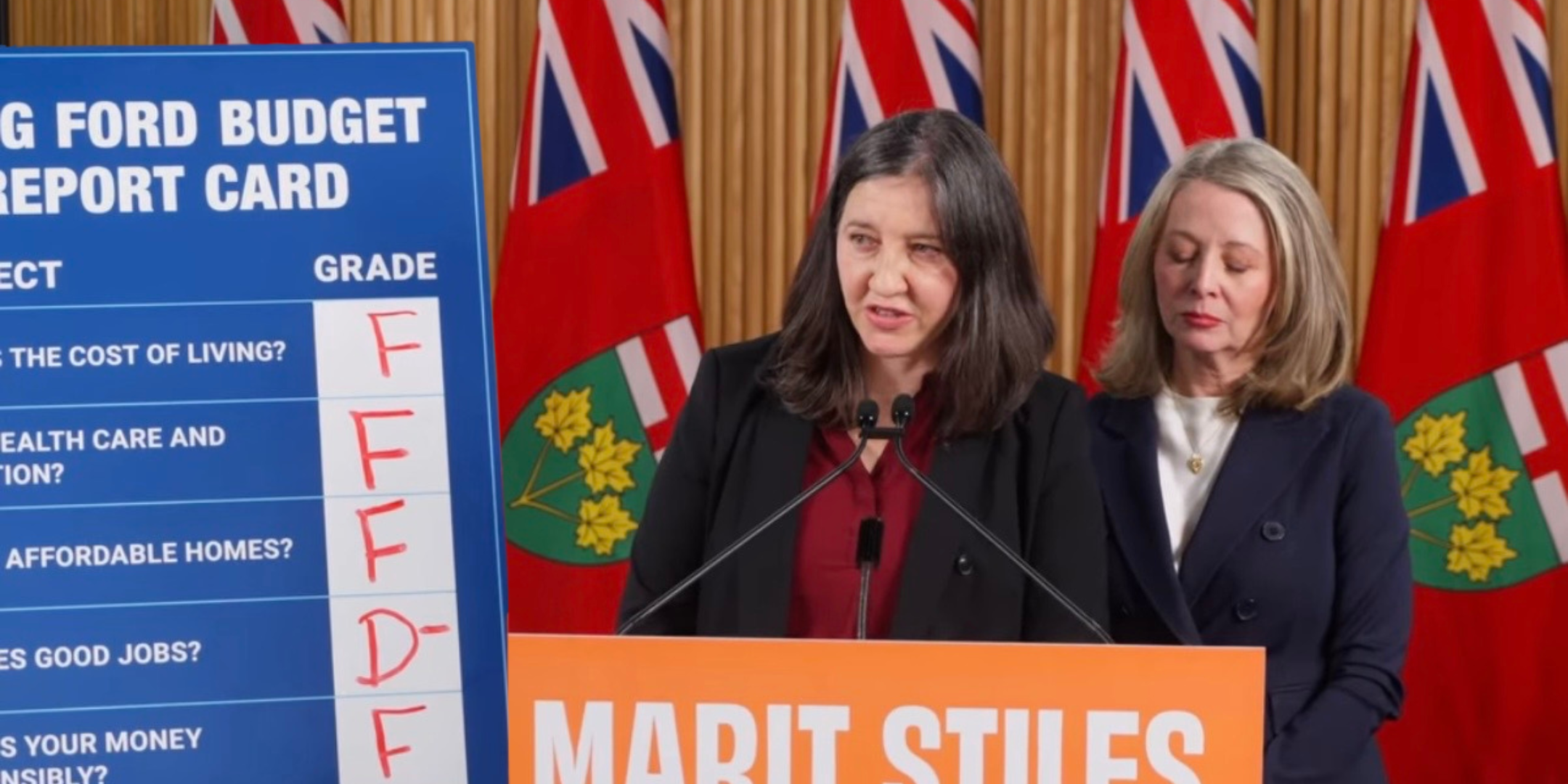
We released a report card grading Doug Ford’s budget, which was released yesterday, on its progress at fixing five very important issues facing Ontarians - health care, education, housing, affordability, jobs. Did Doug Ford’s budget pass the test? No.
The Conservatives’ budget did not pass the test to make everyday costs like rent and groceries cheaper.
Life in Ontario has gotten very expensive. Rent keeps going up. Food prices are very high, and at the same time, big landlords and grocery giants are making nice profit.
We would have liked to have seen the government intervene and bring in stronger rent control to stabilize rent, and meaningful action on grocery price gouging. But they didn’t.
There is no new meaningful policy in this budget that is going to make life more affordable.
The budget did not fix the big problems facing health care and education - problems the Conservatives helped create.
While we did see a decent increase in funding to build more hospitals, the investment in primary care and hospital operating funding is below the rate of inflation.
What this means is the issues we see in health care today will continue. A million Torontonians will continue to hunt for a family doctor. Emergency rooms will remain overcrowded. Staffing shortages will continue.
The Conservatives’ budget is increasing the education budget at below the rate of inflation. This is a cut.
Come September, kids will be going back to school to overcrowded classrooms and teacher shortages. Kids and teachers will be sweating it out in hot classrooms with no A/C and being told not to drink the water because there’s lead in the pipes as there’s no new funding to address the massive capital repair backlog and fix schools.
The Conservatives are falling woefully short on fixing the housing crisis.
Housing is too expensive to rent or buy. Homelessness is just getting worse. Housing starts are plummeting, and are well below target.
We would have liked to have seen a real plan to get the government back into the job of building affordable housing, along with changes to speed up the construction of housing we need, such as affordable rental, senior and student housing.
What we got was a cut to the Municipal Affairs and Housing ministry, which funds affordable housing. We also got an HST cut on all new home sales, instead of just a HST cut for first-time home buyers. This is bad for two reasons: it means we’re losing valuable tax revenue, and first-time home buyers have lost their small advantage when they’re competing to bid on a new property, because inventors now benefit from the very same tax break.
Please read our blog for a more detailed breakdown on the budget.
We are returning to the legislature on Monday to push for the changes we want to see on the core issues that matter, from building affordable housing to better public health care to making our province affordable.
Sincerely,

Jessica Bell
MPP, University-Rosedale
In this newsletter:
- Ontario’s budget is out. Have your say at our Town Hall
- Climate change hearings confirm Doug Ford has no climate plan
- Conservatives tough on crime bill heads to committee – have your say
- Schools struggle under Ford’s supervisor czar
- Tenant Rights Survey
Climate change hearings confirm Doug Ford has no climate plan
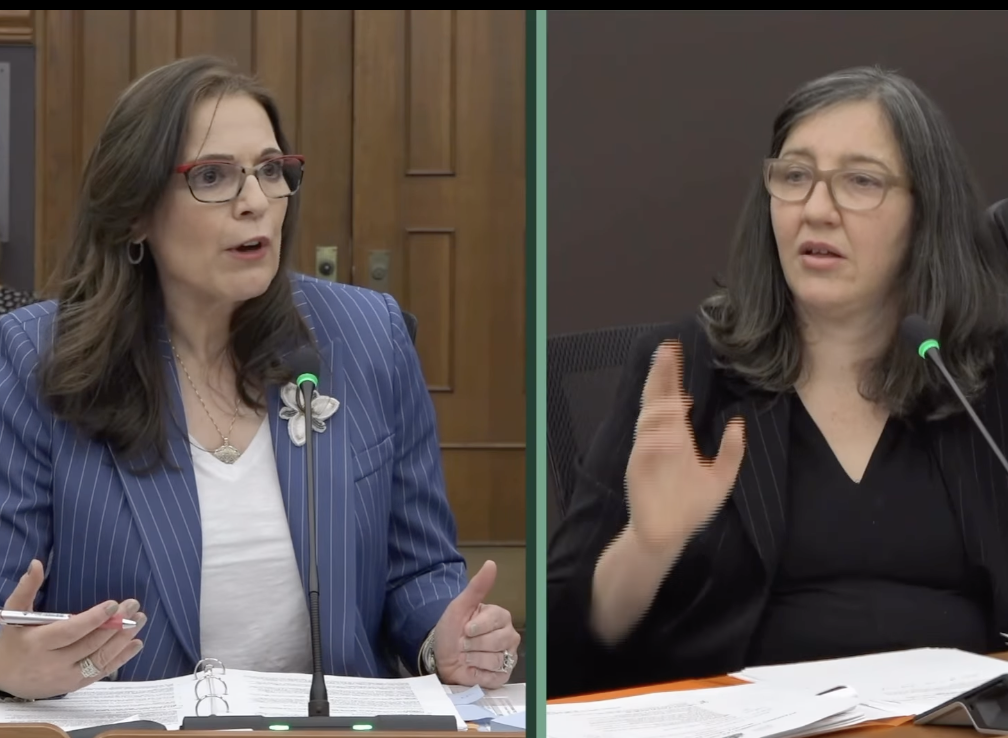
On Monday, March 23, I questioned government officials at the Standing Committee on Public Accounts during hearings into the Auditor General’s 2025 report on Ontario’s climate plan.
The Auditor General found that Ontario does not have a credible plan to meet its 2030 greenhouse gas emission target, and the government has no plan beyond that.
I read this report with dismay and alarm. The Conservatives have abandoned any pretense of protecting people from the impacts of climate change. It reflects a mindset of taking what you can now and leaving the future to burn.
During the hearing, I asked ministry officials about four key issues.
First, I asked about the government’s plan beyond 2030. Officials confirmed they are not developing one because the economic climate doesn’t allow for it.
Second, I asked whether the government is on track to meet its 2030 target. Officials said there are programs in place, but would not say how far along they are or whether those measures will actually get us there.
Third, I asked what the government’s plan is to adapt to climate change. Officials were very reluctant to share specifics on how Ontario is preparing for extreme heat, flooding, and other impacts. We are following up to get more information.
Finally, I asked about plans to reduce emissions across key sectors. Officials pointed to individual initiatives, but were unable to show how those pieces add up to a credible, overall plan.
From what I can tell, the government has no transparent, accurate, or coordinated plan to reduce emissions or prepare Ontario for a hotter and more volatile climate.
Climate change is already leading to rising insurance costs, expensive cleanups, extreme heat in summer, and a longer and more dangerous wildfire season.
This lack of action will result in a future where living standards are lower, life expectancy is shorter, and we are unprepared for the growing costs of emergencies and extreme weather.
We have a responsibility to our children and future Ontarians to get our greenhouse gas emissions to net zero by 2050 and adapt so we can withstand our changing climate. And, despite what we heard in committee, protecting the environment is a job-creator.
Thank you to the groups who came and shared their feedback ahead of these hearings including Environmental Defence, Canadian Association of Physicians for the Environment, and Clean Indoor Air Toronto. I encourage you to get involved and support these organizations doing the important work on climate.
I will continue to work with the Auditor General and the public accounts committee to push for a meaningful response to climate action.
Conservatives tough on crime bill heads to committee – have your say
This week, Bill 75, the Keeping Criminals Behind Bars Act, was debated at Second Reading and referred to committee on Wednesday, March 25.
Bill 75 is a large omnibus bill. While it includes a few sensible measures, it does not include the investments needed to actually reduce crime or improve public safety.
Here’s what Bill 75 proposes:
- Brings in “cash bail,” requiring people or their families to pay money up front to get out on bail. That risks creating a two-tier justice system where freedom depends on how much money you have.
- Expands reliance on sureties, pushing more responsibility onto friends, parents, and grandparents to supervise someone on bail — a role most people aren’t trained for and shouldn’t be forced into.
- Bans breeding cats and dogs for research in Ontario, and adds restrictions and penalties around certain invasive animal research.
- Toughens traffic penalties, including longer licence suspensions and higher fines for dangerous driving offences.
Ontario’s bail system is overwhelmed because of court backlogs, staffing shortages, and limited access to legal representation.
We are calling for a more comprehensive public safety strategy that focuses on measurable investments such as:
- Hiring additional judges, prosecutors, and court staff to reduce bail and trial backlogs.
- Expanding access to legal aid so people can secure timely legal representation and comply with bail conditions.
- Doubling the ODSP and OW rates to help get people out of deep poverty.
- Investing in at least 36 000 supportive housing units to reduce homelessness.
Now that the bill has been referred to committee, you can get involved by requesting to appear as a witness (with the option to submit written materials), or by submitting written comments.
You can sign up here. When applying, select Bill 75.
If you have questions, please reach out to my office at [email protected]
Schools struggle under Ford’s supervisor czar
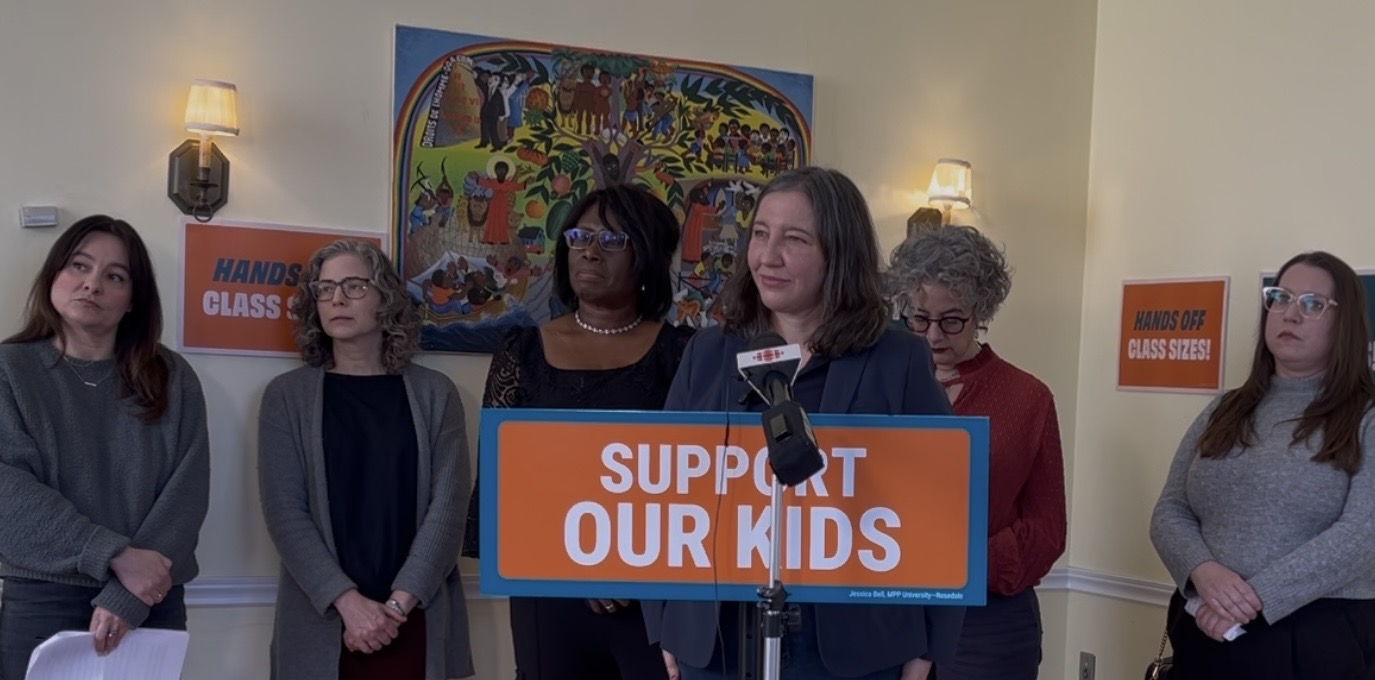
On Monday, March 23, Education Minister Paul Calandra signaled that “significant change” is coming to Ontario’s school boards, with new legislation expected soon that could further reshape or weaken the role of elected trustees.
We only need to look at what’s happened since the Conservative government took over the the Toronto District School Board (TDSB) to see that supervision from Queen’s Park is just going to exacerbate the challenges facing our schools.
Last year, the Ford government put the TDSB under provincial supervision to address so-called financial mismanagement.
Oversight of the TDSB was taken from elected school board trustees and handed to supervisor, Rohit Gupta – a finance professional with no direct experience in the classroom. Mr. Gupta earns $350,000 a year.
Have our schools improved since the takeover? No. It’s gotten worse.
The official way for a parent to raise an issue is to first go to the teacher, then the principal, the superintendent, and then the trustee. With the trustee removed, it’s become a bit wild west.
The school community, including our office, regularly reach out to the supervisor, but he rarely responds.
At the same time, we are seeing cuts and troubling decisions. Special education class sizes have increased, leading to the loss of teachers at schools like Beverley School and Lucy McCormick School. The cap on Grades 4 to 8 class sizes has been removed, meaning ultra-large classes are coming this September. Teachers are already reporting classrooms with over 35 students and not enough support.
We are also seeing signs that schools may be at risk of closure or sale. Schools like Eastdale and Heydon Park have been told to stop accepting new Grade 9 students, raising fears they could be shut down. At the same time, there is growing pressure to redevelop public school land. The TDSB is currently fighting a City decision that protects school lands from redevelopment, which could allow housing to be built on school sites.
I will continue to advocate with parents, students and educators to protect and improve our public school system.
Please contact our office at [email protected] if you have a story that you would like me to raise with the Conservative government, or if you’d like me to attend a local parent council meeting.
Tenant Rights Survey
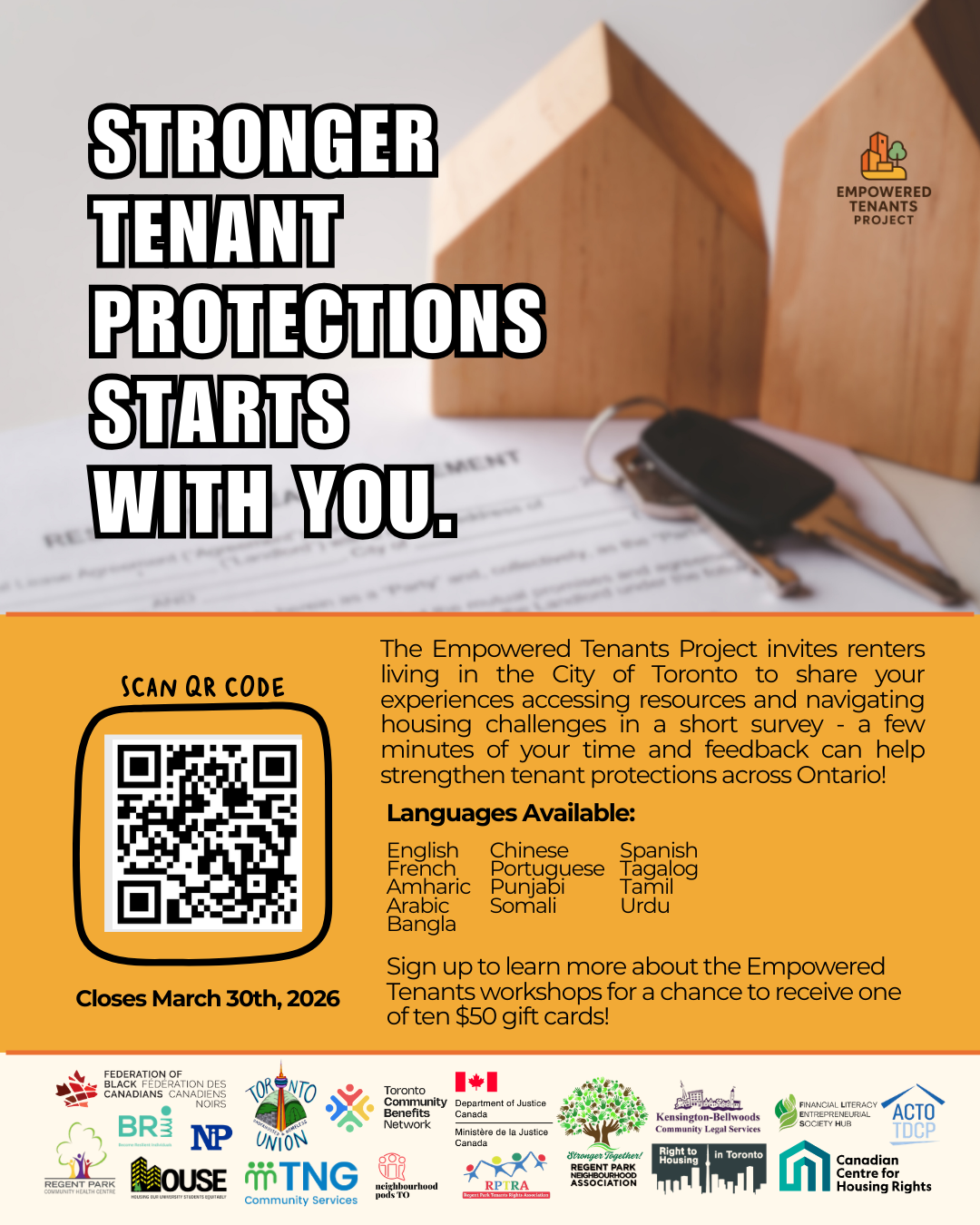
Tenants across Toronto are being asked to share their experiences through a short Tenant Rights & Legal Knowledge Survey led by the Regent Park Neighbourhood Association as part of the Empowered Tenants Project.
With eviction filings on the rise and many renters struggling to navigate their rights, this survey is an opportunity to help shape better protections, stronger legal supports, and more accessible information for tenants.
If you are a renter, roommate, or subletter in Toronto, your voice matters. The survey is anonymous, takes just a few minutes, and is available in 13 languages.
Deadline: March 30, 2026
Take the survey here.
Your input will help inform tenant education, advocacy, and policy recommendations to strengthen renter protections.
I encourage you to take part and share this with others.