Dear neighbour,
Over the last few months, I’ve spoken with many parents, teachers, and students who are deeply worried about what’s happening in our schools. From overcrowded classrooms to the loss of special education support, it’s clear that chronic underfunding is taking a toll on our kid’s learning and well-being.
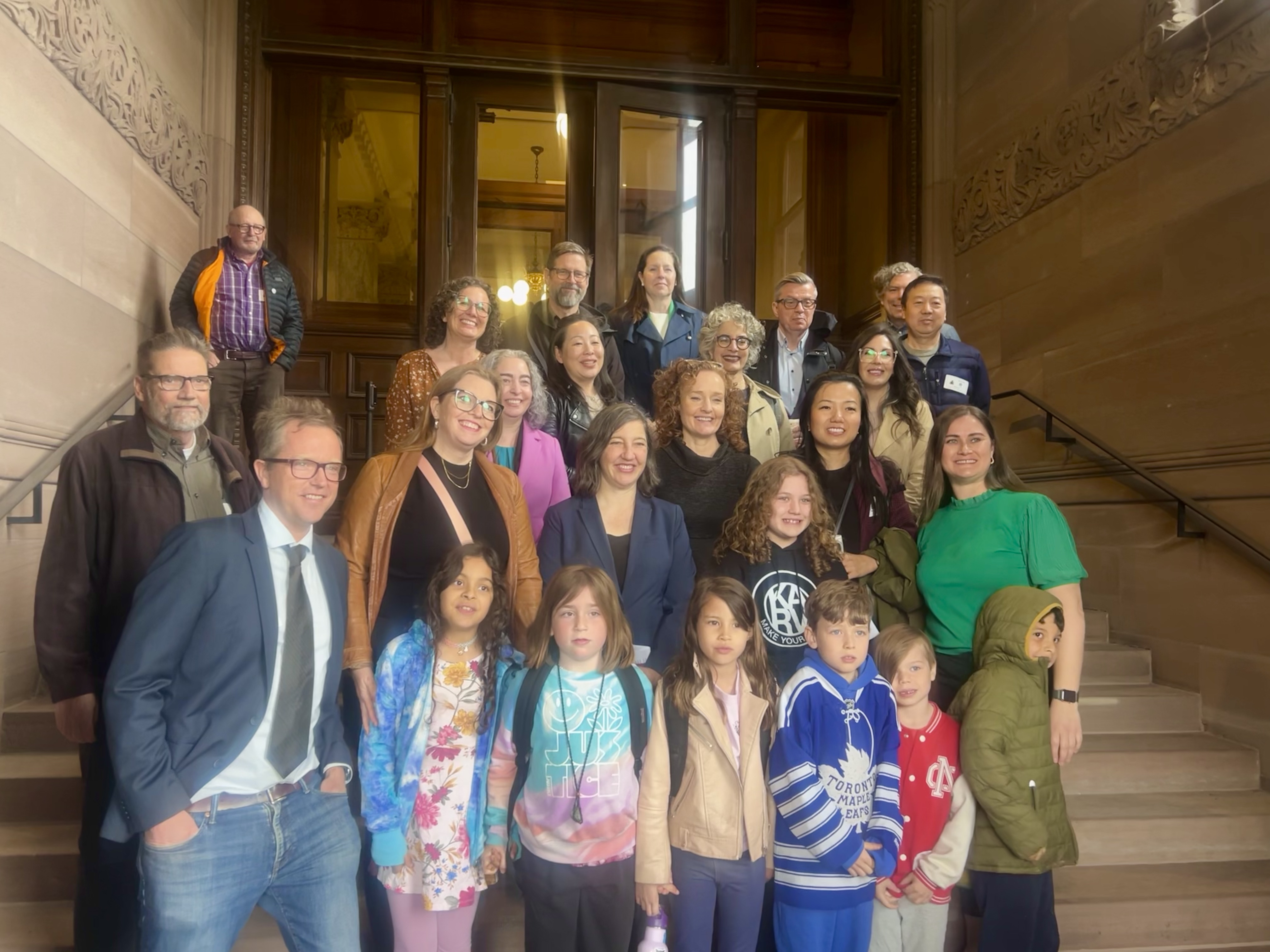
On May 8, I joined the Fund Our Schools coalition at Queen’s Park to call on the Ford government to stop blaming school boards and start properly funding public education. The coalition—which includes the Elementary Teachers of Toronto, OSSTF Toronto, CUPE 4400, the Toronto & York Region Labour Council, TECT, and the Ontario Autism Coalition—has a clear picture of the challenges in our classrooms and what solutions are needed.
The Toronto District School Board is already facing a yawning financial gap between what the Ministry of Education requires the board to deliver and what it actually provides in funding. Since 2018, schools in Ontario have lost about $1,500 per student when adjusted for inflation. This has resulted in larger classes, cancelled programs, delayed repairs, and a growing crisis in special education.
We need to turn this around. That’s why I’m helping to organize a rally at Queen’s Park on Friday, May 24 at 12:00 p.m. to demand proper investment in public education. Join parents, students, educators, education workers, and community members from across Ontario. This is a family-friendly, accessible event. Bring your signs, your stories, and your support.
Click here for more information and to RSVP.
Let’s keep working together for the schools our kids deserve.
Sincerely,
Jessica Bell
MPP, University-Rosedale
In this newsletter:
- New public safety bill raises red flags on judicial independence
- New bill raises concerns over public health oversight and data privacy
- The anti-environment Bill 5 moves to committee, have your say
- Why won’t the Ford government commit to investing in our public education?
- ONDP Demanding No Claw Backs to Canada Disability Benefit
- Layoffs at Thunder Bay transit plant renew our push for a buy Ontario-built in Ontario approach
- New municipal misconduct bill
- Where is the plan to contain the measles outbreak?
New public safety bill raises red flags on judicial independence
On May 1, the Ford government introduced Bill 10, Protect Ontario Through Safer Streets and Stronger Communities Act, 2025. The bill includes a wide range of justice system reforms but as Shadow Attorney General Kristyn Wong-Tam pointed out, many of these changes are more about political control than improving public safety.
The most serious concern is Schedule 5, which gives the Attorney General greater influence over judicial appointments. Under the new rules, candidates would be classified as "not recommended," "recommended," or "highly recommended," based on criteria that must now include anything the Attorney General specifies. Combined with Premier Ford’s recent comments suggesting judges should be elected and the appointment of former Ford staffers to judicial selection committees, this raises serious questions about the government’s respect for judicial independence.
The bill also changes how sureties—family or friends supervising someone on bail—must report to the government, with fines for noncompliance. Legal advocates warn this could make it harder to find a surety and delay release, especially when community-based bail programs remain underfunded.
Other parts of the bill expand who can apply for restraining orders in cases of intimate partner violence. While that’s a positive step, the bill doesn’t act on any of the 68 recommendations from the Renfrew County Inquest into femicide, which focused on housing, financial supports, and systemic reform.
I want to hear your thoughts on this bill. Please email me at [email protected]. To make a written submission or request to appear at committee, follow this link.
New bill raises concerns over public health oversight and data privacy
On May 5, the Ford government reintroduced The More Convenient Care Act, now numbered Bill 11. While the government claims it will modernize the healthcare system, the bill makes sweeping changes that could weaken local public health oversight, and put Ontarians’ personal health data at greater risk.
Here’s what's in the bill:
-
Schedule 3 creates new reporting rules for private healthcare staffing agencies but doesn’t regulate what they can charge. Agencies must submit data on billing and pay, but they’re not required to show how much goes to workers versus profits.
-
Schedule 4 limits the authority of local Medical Officers of Health. Under the bill, they must now get written approval from the Chief Medical Officer before issuing public health directives related to infectious diseases, effectively centralizing power and limiting local response in a crisis.
- Schedule 6 enables a new prescribed organization to manage Ontario’s digital health IDs. The Information and Privacy Commissioner has previously raised concerns about the scope and oversight of personal data collection. The bill expands what can be collected, used, or disclosed.
None of these proposals address the root causes of Ontario’s healthcare staffing crisis, like underfunding, low wages, or lack of full-time work.
We’ll be watching this bill closely. If you have concerns about Bill 11, email us at [email protected].
The anti-environment Bill 5 moves to committee, have your say
Bill 5, Protect Ontario by Unleashing Our Economy, has been referred to the Standing Committee on the Interior. This 229-page omnibus bill gives the government sweeping powers to override environmental protections, heritage rules, and public consultation by creating “Special Economic Zones.” It also repeals the Endangered Species Act and weakens Indigenous consultation requirements, setting a troubling precedent for development without proper oversight.
Public hearings will be held:
-
May 22: 10:00 a.m. – 12:00 p.m. and 1:00 p.m. – 5:00 p.m.
-
May 26: 9:00 a.m. – 10:15 a.m. and 1:00 p.m. – 6:00 p.m.
If you want to speak at committee, you must apply by May 12 at 2:00 p.m. Written submissions are due by May 26 at 6:00 p.m.
To apply or submit comments, visit: ola.org/en/apply-committees
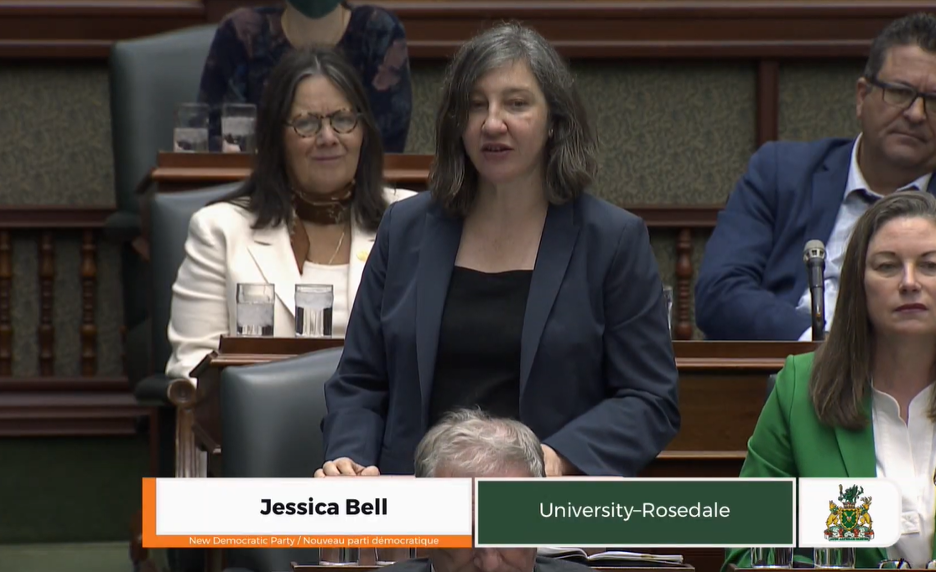
Why won’t the Ford government commit to investing in our public education?
The Toronto District School Board is looking at making major cuts to schools because of chronic underfunding by the province. The board is currently looking at closing nearly half its swimming pools, axing music programs, and there are huge funding gaps in special education and mental health.
On May 8, I asked the Minister of Education a simple question. Can this government commit to re-investing that $1,500 per student back into our schools so our kids can see improvements in the classroom?
Parents do not want this government playing political blame games with the school board. They want their kids to get a good public school education, and that requires investment. Watch the question here.
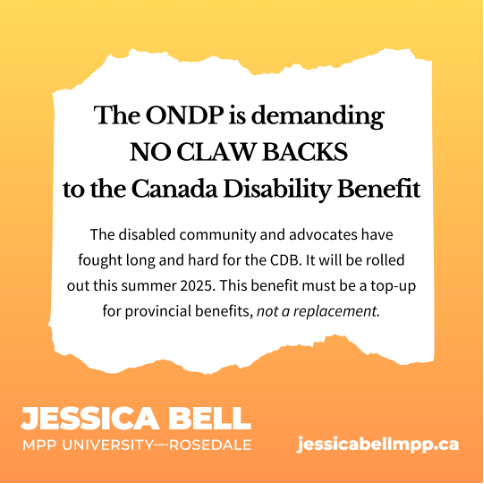
ONDP Demanding No Claw Backs to Canada Disability Benefit
The new Federal Canada Disability Benefit (CDB) is scheduled to roll-out this summer with eligible recipients expecting to receive their first installment in July 2025. This benefit is a cornerstone initiative of Canada’s Disability Inclusion Action Plan - a whole-of-government approach to improve the lives of disabled people in Canada. The CDB aims to reduce poverty among working age disabled folks.
In recent months, our office has been hearing from disabled folks and disability advocates who are appalled by Alberta's decision to claw back the Federal CDB for individuals receiving provincial disability support. I am equally appalled. The ONDP is firm that the CDB must be a top-up for provincial benefits, not a replacement.
I have written to Premier Doug Ford and Minister Michael Parsa (Ministry of Children, Community and Social Services) calling on the Ontario government to join Saskatchewan, Newfoundland and Labrador, Nova Scotia, Manitoba, Nunavut, Quebec, and British Columbia and announce immediately that we will not claw back social assistance for disabled people. All 27 of my ONDP colleagues have signed on to this letter.
Layoffs at Thunder Bay transit plant renew our push for a Buy Ontario-Built in Ontario Approach
On Monday, May 6, I joined Ontario NDP Leader Marit Stiles and MPP Lise Vaugeois to call on the Ford government to bring in stronger Canadian-content requirements for public transit manufacturing.
About 200 workers at the Alstom facility will be laid off between mid-May and the end of August, coinciding with the end of the plant’s current TTC streetcar contract. These job losses come just as the TTC is finalizing a decision on a $2 billion contract for 55 new subway trains for Toronto’s Line 2, funded by the City of Toronto, the Province, and the federal government.
Thunder Bay has the capacity and workforce to deliver this work. But without clear procurement rules that prioritize Ontario-built transit, these jobs could go elsewhere.
We’ve already seen the consequences of weak procurement policy. The $9 billion Ontario Line is being built in the U.S., sending billions in public dollars and job opportunities out of the province.
The Ontario NDP is pushing for long-term rules that require higher Canadian content in the construction of streetcars, buses, and subway trains. This would help keep Ontario workers employed and local factories running at full capacity. Our goal is to protect good Ontario jobs and ensure that publicly funded transit vehicles are built here at home.
New municipal misconduct bill
On May 1, the Ford government introduced Bill 9, the Municipal Accountability Act, 2025, which would change how municipal councillors can be removed for serious misconduct, including harassment or actions that harm public safety.
Under the proposed law, councillors found to have violated a standardized code of conduct must be reviewed by two separate integrity commissioners. First locally, then by Ontario’s provincial Integrity Commissioner. Only after both investigations confirm serious misconduct, and only with a unanimous vote by the rest of council, could a councillor be removed from office.
Municipal integrity experts have raised concerns that the bill centralizes power in Queen’s Park by allowing the province to override local codes of conduct and investigation procedures. There are no guarantees of support for small municipalities or a public registry of decisions, as integrity commissioners and municipalities have long requested.
The Ontario NDP has repeatedly called for stronger measures, including giving judges, not councillors, the final say on whether an elected official should be removed. MPP Jeff Burch previously introduced the Municipal Accountability and Integrity Act, 2024 to that effect.
I want to hear your thoughts on this bill. Please email me at [email protected]. To make a written submission or request to appear at committee, follow this link.
Where is the plan to contain the measles outbreak?
On May 7, Leader of the Official Opposition Marit Stiles called on the Ford government to take immediate action on Ontario’s escalating measles outbreak.
Ontario has now recorded more than 1,380 confirmed measles cases, the worst outbreak in decades and far ahead of what we’re seeing in neighbouring jurisdictions. Families are worried about accidental exposure, but the government has yet to lay out a real, coordinated plan to protect people.
We are calling on the government to launch a province-wide public education campaign about the MMR vaccine, which is free, safe, and effective. Public health units also need dedicated funding and coordination to respond quickly to outbreaks and boost vaccination rates in low-coverage communities.