

Dear neighbour,
This week, Ontario MPPs debated and voted on “Lydia’s Law,” named after a woman from Waterloo Region who reached out to MPP Catherine Fife with concerns about the long and painful court process she experienced after reporting a sexual assault.
Last year, 1,639 sexual assault cases were withdrawn or stayed before trial in Ontario. Lydia’s Law would strengthen accountability and transparency in how sexual assault cases are handled, including tracking delays and improving access to support for victims. The Conservatives voted Lydia’s Law down.
It isn’t just sexual assault. I took a look at this document that tracks offenses in the court system, and I was shocked by the sheer number of cases that are dropped, largely because of court delays: 102 homicide cases. 143 attempted murder cases. 12,870 break and enter cases.
I want a safe Ontario, just like everyone else. No one should have to worry about their safety or fear violence as they get on a train, go on a date, or go to sleep with their family in their own home.
Reducing crime is not going to be solved by bluster. It’s going to require investment in schools, colleges and universities, measures to reduce poverty, addiction and homelessness, a job creation plan to tackle unemployment, and ensuring our court system can promptly administer justice.
Lydia is not giving up. Neither are we.
Sincerely,
Jessica Bell
MPP, University-Rosedale
In this newsletter:
- Join our Bay St Area Community Townhall - June 9
- Committee hearings for the Billy Bishop Airport bill show just how terrible this plan is
- Ontario is not ready for the climate crisis. It should be.
- What’s in the Conservatives’ new crime bill
- Standing up for public health care
- Solidarity with striking frontline social service workers
- Building Tenant Power in University-Rosedale
- Have your say on the Queen’s Park North proposal
- Help reimagine Croft Street laneway
- Refugee Art Show at Friends House
Join our Bay St Area Community Townhall - June 9
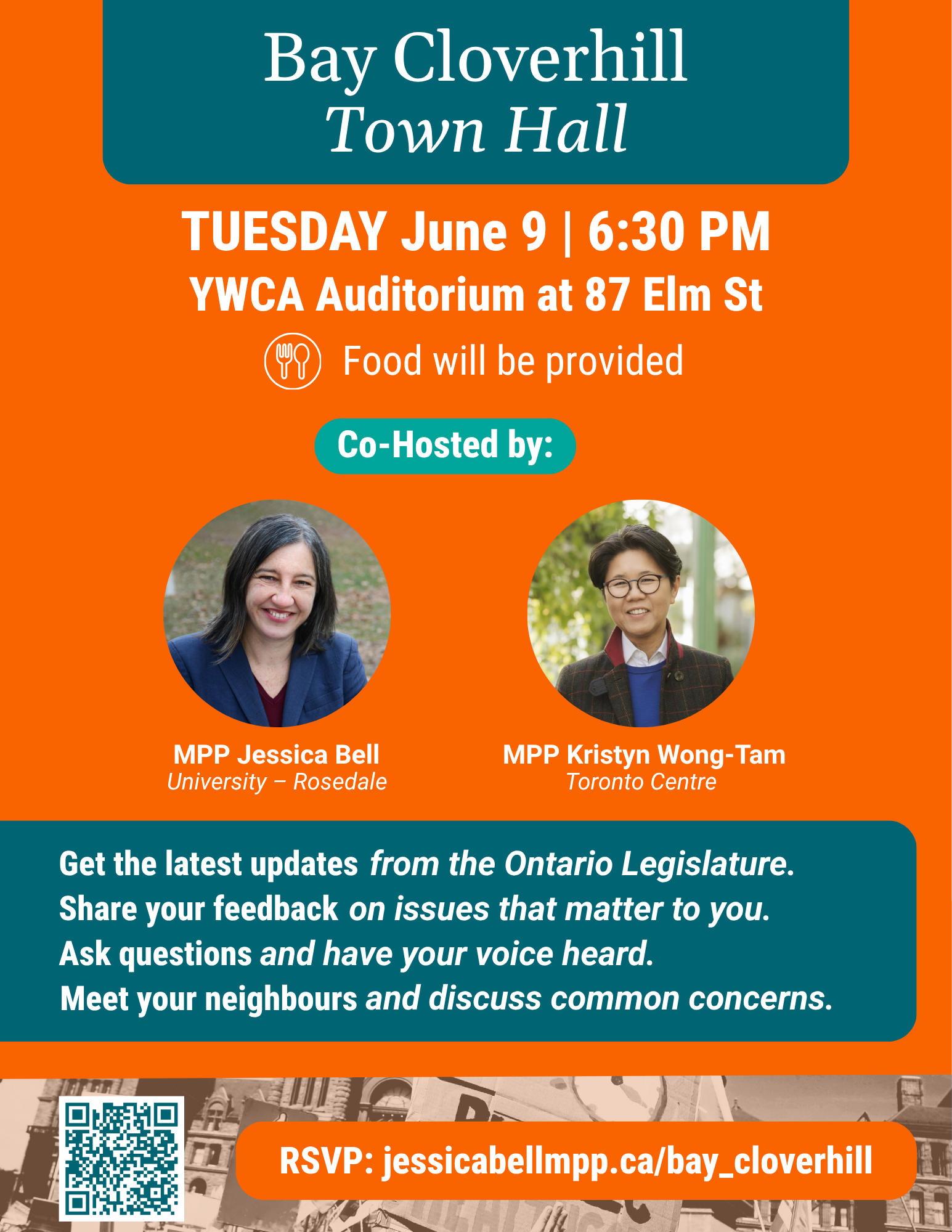
Join myself, MPP Kristyn Wong-Tam, community groups, and residents for a Community Townhall in the Bay St Cloverhill neighbourhood.
We’ll share provincial updates, answer questions, hear your feedback, and talk about the issues affecting our community.
Food provided
When: Tuesday, June 9 at 6:30 PM
Where: YWCA Auditorium at 87 Elm Street
You can RSVP here or in the button below.
Committee hearings for the Billy Bishop Airport bill show just how terrible this plan is.
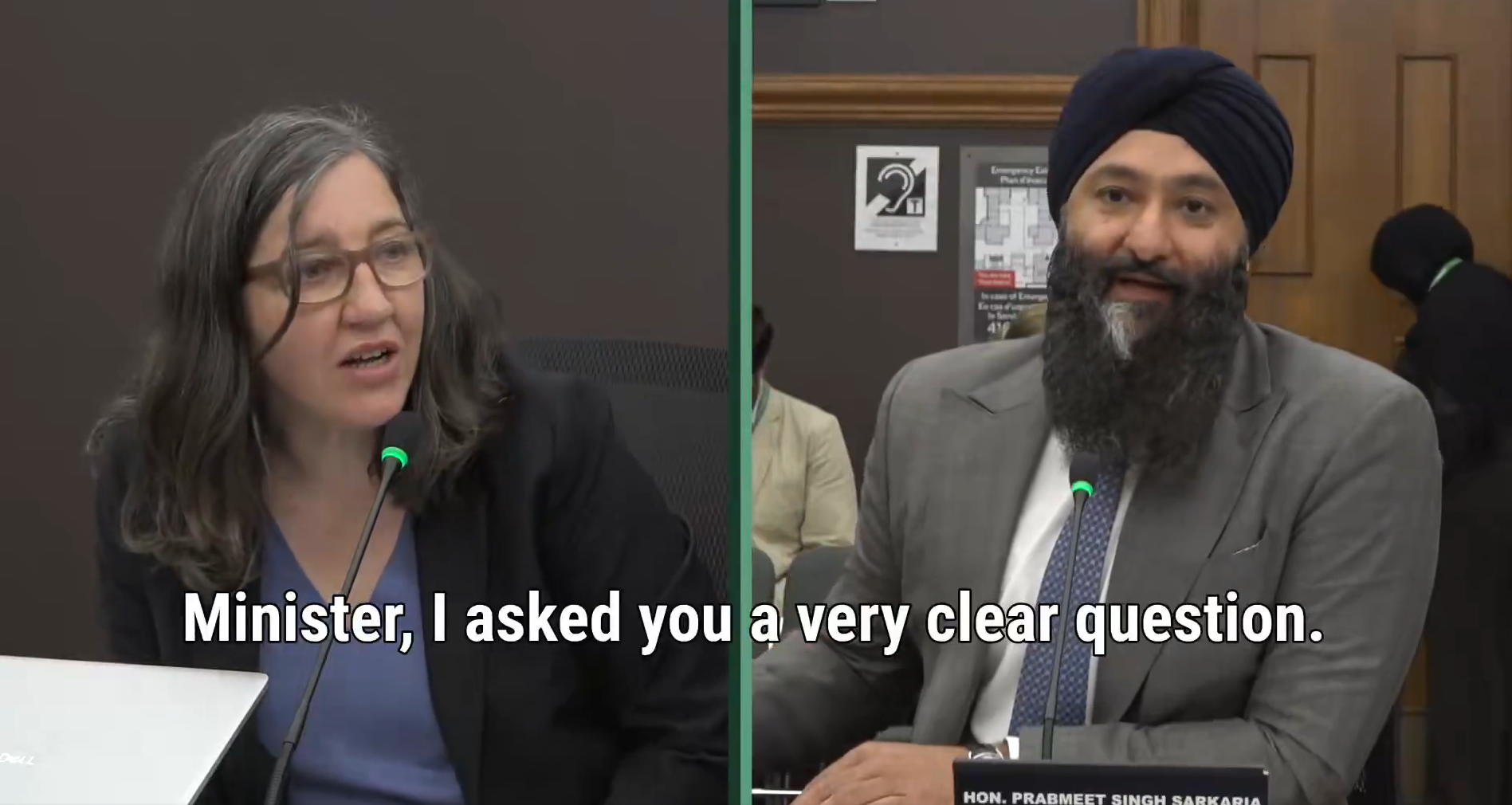
On Tuesday, May 19, I joined my Ontario NDP colleagues MPP Chris Glover, MPP Kristyn Wong-Tam, MPP Sol Mamakwa, and MPP Alexa Gilmour at committee hearings on Bill 110, the Conservative government’s legislation to replace the city in the tripartite agreement that oversees the Billy Bishop Airport and takeover Norway Park and most of Toronto Island.
During these hearings we got to ask questions directly to Transportation Minister Prabmeet Sarkaria and President of the Toronto Port Authority RJ Steenstra. We also heard from presenters including former Toronto mayor David Crombie, Clean Air Toronto, NoJetsTO, the Canadian Association of Physicians for the Environment (CAPE), Friends of Kensington Market, and the Bathurst Quay Neighbourhood Association.
Thank you to everyone who presented and to the more than 350 people and organizations who submitted written materials on the bill.
This is what we learned in committee.
The expansion will cost an astronomical $4 to $5B. The Port Authority said the money will be recouped from passenger air fares, but how could this be feasible given that air fares are already sky high and Pearson has more than enough runway capacity to meet demand. I think this project is only viable if it comes with a massive government handout.
The Port Authority confirmed they are developing a business case but it is not final, nor public. We did not get confirmation if the business case will assess the negative impact of the project on nearby housing construction, property values, and impact on tourism and small business revenue.
No fulsome environmental assessment has been completed.
Downtown Toronto residents’ health will be harmed by the airport expansion. Dr. Milli Roy from CAPE’s testimony showed clear documented evidence that the Billy Bishop Expansion plan will increase pollution and put people’s health at risk. Dr. Roy shared how almost all particulate emissions from jets are ultrafine particles, which are small enough to enter the bloodstream and travel throughout the body. These particles are linked to asthma, bronchitis, heart attacks, stroke, dementia, diabetes, lung cancer, low birth weight, and other serious health impacts. Air quality monitoring in Bathurst Quay found Billy Bishop is already the single largest source of ultrafine particles in Toronto, and particle levels can double or triple when the wind blows from the airport into the neighbourhood.
On Thursday, May 21, I joined MPP Chris Glover for a clause-by-clause review of the bill. Clause-by-clause is the stage where MPPs can introduce amendments and debate changes to legislation section by section before it becomes law. We put forward amendments that would have required:
- A public statement of support from the federal government before the land transfer could proceed;
- a full environmental impact assessment;
- a health equity impact assessment;
- a public business case for the expansion;
- protections for the Toronto Islands; and
-
guarantees that worker health and safety laws would be enforced during construction.
The Conservatives voted against every single amendment.
Bill 101 passed at third reading on Thursday, May 28. But this fight isn’t over. Here are three things you can do to help continue the momentum to protect our waterfront.
-
Connect with NoJetsTO.
- Sign the petition to stop the Billy Bishop airport expansion here.
- Contact your local Liberal MP and ask them to quash this airport expansion. The federal government has the authority to stop this expansion.
What’s in the Conservatives’ new crime bill

On Monday, May 28, the Ford government introduced Bill 119, the Protecting Ontario’s Streets and Communities Act, 2026. This omnibus bill makes changes across policing, adoption, restraining orders, human trafficking, tow truck enforcement, the sex offender registry, police record checks, animal welfare, and more.
We’re still digesting what this bill means, but this is what we think is important for you to know about the bill so far:
- Creates new rules around adoption and intercountry adoption, including approvals for adoption practitioners and new licensing rules.
- Youth in secure custody or secure temporary detention to be placed in a locked room under rules that would be set later in regulation.
- Expands Christopher’s Law, Ontario’s sex offender registry law, to align reporting requirements with federal sex offender registry obligations.
- Gives the Minister more power over police service boards, including the ability to issue directives setting priorities that boards must reflect in their strategic plans, and restricting who can attend police service board meetings.
- Creates a public high-risk offender website, where certain personal information about people convicted of federal or prescribed offences could be published for public safety.
- Makes restraining orders issued by courts in other Canadian provinces and territories enforceable in Ontario.
- Creates a new provincial law restricting the possession, sale, and use of pill presses and precursors used to make illegal drugs. Pill presses are typically used by large distributors of illegal drugs.
- Gives municipalities the power to impose administrative penalties for illegal land uses, such as illegal truck yards operating on agricultural land. This is a big issue in the Caledon area.
- Makes changes intended to speed up police record checks, including vulnerable sector checks, by allowing police services to apply to have an outside body designated to conduct certain checks. The details of who can provide these checks would be set later in regulation.
- Makes it easier for survivors of human trafficking to not have to pay off or be economically harmed by coerced debt. Coerced debt is debt that was taken on because a trafficker manipulated, exploited, or forced a survivor into borrowing money, signing contacts, opening accounts, or taking on financial obligations.
- Strengthens enforcement rules for tow trucks at collision scenes.
- Allows earlier interim suspensions for social workers and social service workers facing serious allegations of professional misconduct.
There are parts of this bill that make sense. Restraining orders from other provinces should be enforceable here. Municipalities need better tools to deal with illegal land uses. Survivors of human trafficking should not be forced to carry debts that were coerced by their traffickers.
But there are also serious questions, such as why is this government giving the minister huge power to set the priorities of police boards and police forces? What exactly will the locked provisions for youth in secure custody look like? And if police record checks are contracted out to a for-profit business, then what is being done to ensure our privacy is being protected?
We want this bill to go to committee so we can better understand the consequences of these proposed changes. If you have feedback on sections of this bill, then please contact us at j[email protected].
Ontario is not ready for the climate crisis. It should be.
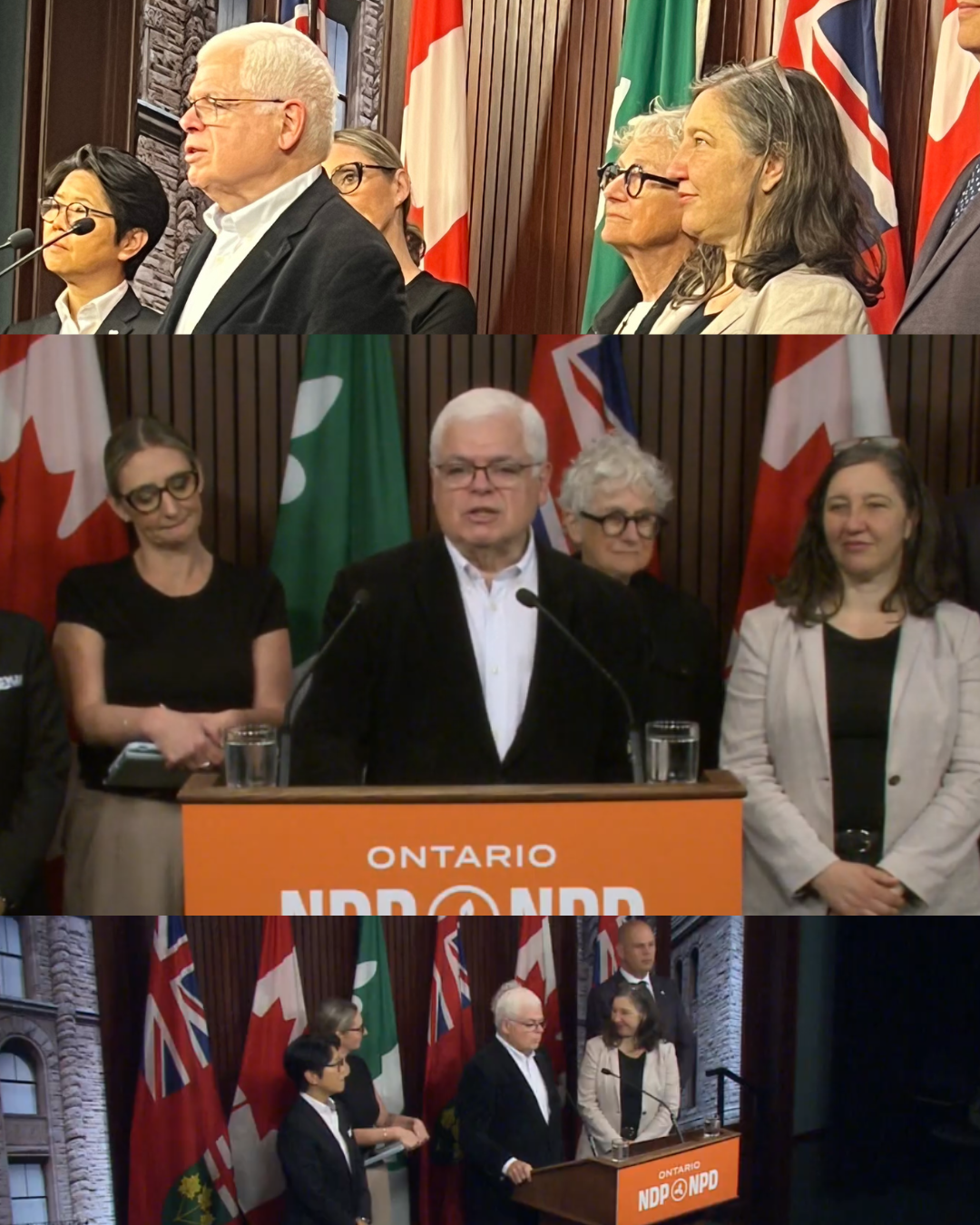
On Thursday, May 28, I joined MPP Peter Tabuns, MPP Kristyn Wong-Tam and MPP Jamie West at a press conference to talk about the private member’s bill I co-sponsored called the Ontario Climate Change Adaptation and Resilience Act.
This bill calls on the Ontario government to develop a province-wide climate adaptation strategy to protect Ontarians, including workers, from the impact of climate change, including extreme flooding, extreme heat, and urban wildfires.
A major focus of the bill is extreme heat. It calls for heat-risk mapping, public reporting on heat-related deaths and illness, urban cooling strategies like tree canopy expansion and green roofs, a maximum temperature requirement for rental units, and heat-stress protections for workers under the Occupational Health and Safety Act.
During the press conference we heard from Laura Walton, President of the Ontario Federation of Labour, about workers already facing dangerous heat on the job, including childcare workers, firefighters, construction workers, kitchen staff, and many others.
The Ontario Minister of Labour David Piccini says these rules aren’t needed because workers can simply refuse unsafe work. The truth is many workers cannot simply refuse unsafe work. There needs to be clear rules and strong standards for employers to follow to ensure all workplaces are safe.
The bill would require Ontario to plan for the growing risk of wildfires, including urban wildfires. Experts are warning that the kind of climate-fuelled fires we have seen in places like Los Angeles could happen here too. Ontario needs a plan before the next emergency, not after.
The bill also calls for an adaptation fund so municipalities and communities can pay for the work needed to prepare for climate impacts. That could include updating infrastructure, expanding shade and cooling areas, and supporting retrofits for apartment buildings where tenants are living in dangerously hot units without access to air conditioning.
Prevention is better, safer, and cheaper than cleaning up after the next inevitable emergency.
The Ontario government has no meaningful and comprehensive climate plan, no firm targets, no plan explaining how they intend to reduce emissions, no public monitoring of emissions, no comprehensive and clear adaptation plan.
They’ve abandoned their responsibility of preparing us, which is why we’re stepping in to pressure them to take action on the climate file. Here’s how you can help.
Support a local group doing good work, such as Environmental Defence, Toronto Climate Action Network or SCAN.
Send an email to the Minister of the Environment, Conservation and Parks at [email protected] urging the government to develop a strong climate and adaptation plan.
Standing up for public health care
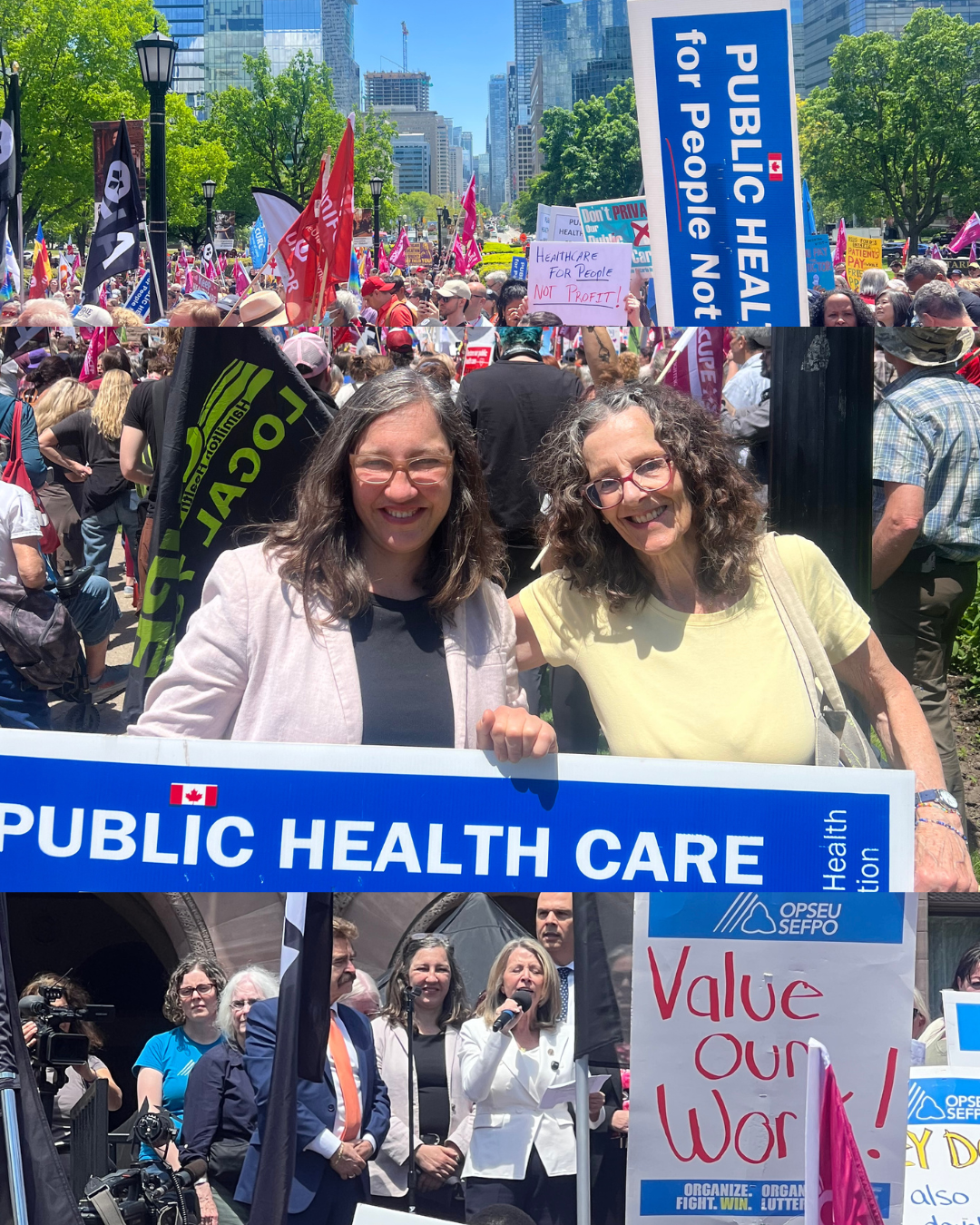
On Thursday, May 28, I joined thousands of people at Queen’s Park for a rally organized by the Ontario Health Coalition to send a clear message to the Ford government to stop privatizing health care and start funding our public hospitals.
Ontario’s public health care system belongs to all of us. We have already paid for it. We need to make sure everyone can access it when they need it, whether that means getting surgery in a public hospital or seeing a family doctor or nurse practitioner close to home.
The Ford government is sending more public health care dollars to private, for-profit clinics while hospitals are being pushed into deficit and forced to cut services.
You can take action and learn more here.
Solidarity with striking frontline social service workers
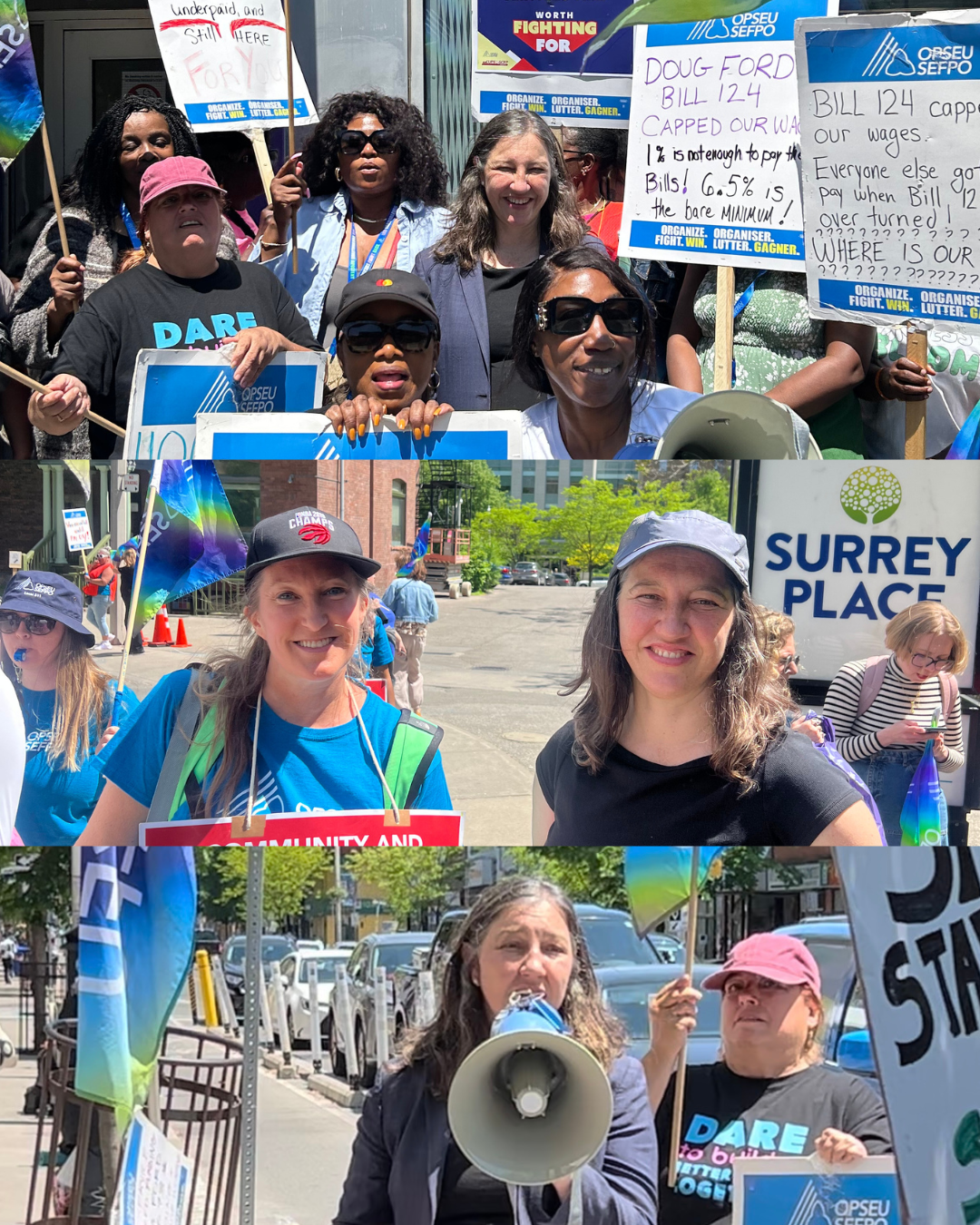
This week I visited the picket lines at Surrey Place and Sistering to support frontline social service workers fighting for fair wages and better funding for the services our communities rely on.
Surrey Place provides support for children, youth, and adults with autism, developmental disabilities, and sensory-related concerns. Sistering is Toronto’s only 24/7 drop-in for women and gender-diverse people, providing low-barrier support to people who are homeless, precariously housed, or facing crisis.
These workers are part of the Worth Fighting For campaign, representing 4,500 frontline social service workers across Ontario who are members of OPSEU/SEFPO. They include social workers, child therapists, addictions counsellors, shelter workers, legal aid staff, and more. Many make less than a living wage while providing critical support to some of the most vulnerable people in our communities.
They are on strike because social services have been chronically underfunded for years. Since 2018, real funding for social services per person in Ontario has been cut by 16.4%. In the 2026 provincial budget, funding for the sector dropped by another 2.4%, and the government still has not closed the $1.5 billion shortfall in the Ministry of Children, Community and Social Services.
The result is low wages, unsafe staffing levels, growing waitlists, service delays, and more pressure on workers and the people who depend on them.
The workers’ demands are clear: provide immediate, sustained funding increases to stabilize community health and social services, and deliver fair, funded wage increases, including the 6.5% retroactive wage increase that other public-sector workers received after Bill 124 was repealed.
These workers care for our communities every day. They deserve fair wages, safe working conditions, and real investment in the services people depend on.
Take action and support a local picket here or by clicking the button below.
Building Tenant Power in University-Rosedale

Over the last couple of months, tenants from multiple rental buildings have reached out to me with concerns about issues in their buildings, including Above Guideline Rent Increases (AGIs), water quality, indoor temperatures, and more.
Our office has been working with tenants, along with organizations including ACORN and the Toronto Tenant Union, to organize tenant meetings, support building organizing efforts, and help tenants uphold their rights.
When tenants work together, they can share information, support one another, and push for better living conditions in their buildings.Are you experiencing issues in your building? Want to organize with your neighbours? Call or email our office at 416 535 7206 or [email protected].
Have your say on the Queen’s Park North proposal

The City of Toronto is reviewing a proposal for changes to Queen’s Park North, supported by a major private donation. The proposal includes ideas such as new park features, food services, washrooms, and other public amenities.
City staff are expected to bring recommendations to the Infrastructure and Environment Committee on June 10.
Friends of Queen’s Park North have raised concerns about the need for more detailed plans before the project moves ahead. Their concerns include the potential impact on mature trees, heritage features, and the overall scale of the proposed changes.
I encourage you to review the proposal on the City’s Queen’s Park North Revitalization page here. Learn how to submit feedback, written comments, or request to speak at committee
Help reimagine Croft Street laneway

The Laneway Project works with communities to transform Toronto’s laneways into greener, safer, and more welcoming public spaces. Through neighbourhood partnerships, co-design, and community-led planning, they help create laneways that are more connected, climate-ready, and useful for the people who live nearby.
The Laneway Project is working with neighbours to reimagine the Croft Street laneway, between Ulster Street and Harbord Street, as a more vibrant and welcoming space for everyone.
The project will run from May to September, starting with community input and leading to a shared design and installation in the laneway.
Residents who live or work near the Croft Street laneway can sign up to get updates, be invited to events, help shape the project, and explore opportunities for improvements on their property, such as a garden, mural, or lighting.
Sign up here to get involved or click on the button below.
Refugee Art Show at Friends House

To mark Refugee Awareness Day, the Quaker Committee for Refugees is hosting a Refugee Art Show featuring work by newcomer artists.
The show will take place at Friends House, 60 Lowther Avenue, near St. George subway station.
Exhibition Hours:
Friday, June 12| 10 am to 9 pm
Saturday, June 13| 10 am to 5 pm
Admission is free and the venue is wheelchair accessible. Sale proceeds go directly to the artists.