
Dear neighbour,
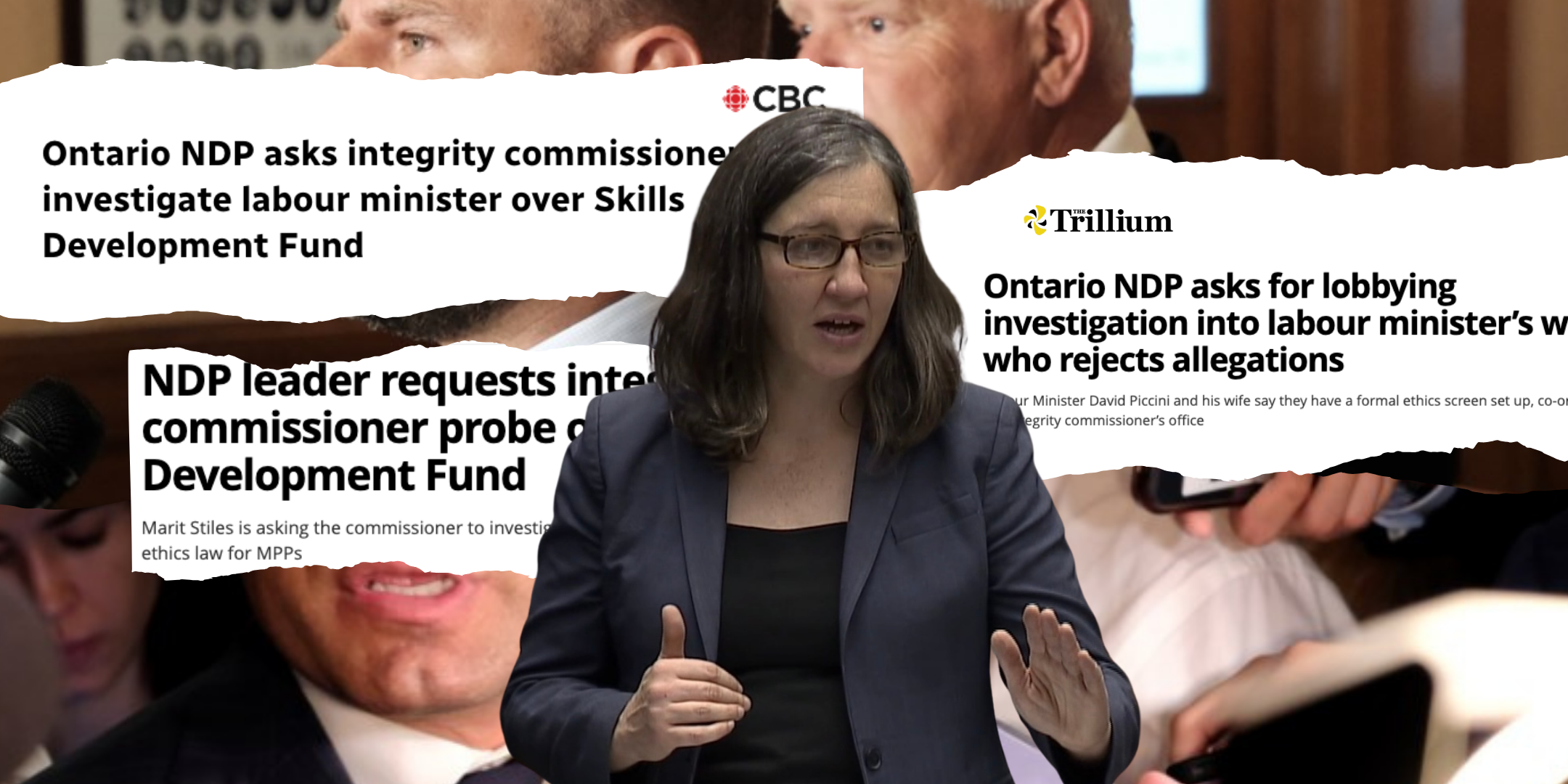
On Monday, November 24, Ontario NDP Leader Marit Stiles filed an ethics complaint with the Integrity Commissioner asking for a formal investigation into Labour Minister David Piccini’s handling of the Skills Development Fund (SDF).
The SDF is a $2.5 billion program that gives money to companies, non-profits and unions to provide training to unemployed workers to help them get a job.
The Auditor General found the government was not fair or transparent when giving out skills training funding.
More than half of the recipients were ranked by impartial ministry staff as poor, low, or medium in delivering on the program’s goals. Poorly ranked recipients received more money overall than higher ranked recipients, and many of the recipients gave thousands of dollars to the Conservative party at about the same time as they received millions of dollars in government funding.
Every day in the legislature, new scandalous information is revealed about the recipients and their ties to the Conservatives. Here’s the latest.
In round 5 of the Skills Development Fund, an Alberta company called Technology North received $900,000. Guess who was the lobbyist for this company? The Minister of Labour’s wife.
The Ford family’s dentist was giving $2M in funding.
Keele Digital Solutions got $7.5M for training after the company was forensically audited by the Ministry of Colleges and Universities for irregularities, and referred to the OPP for investigation.
$10 million to an adult entertainment nightclub - a strip club – run by owner, Zlatko Starkovski, host to many Conservative party fundraisers.
You can’t make this stuff up.
Now that we’ve filed a complaint, it’s up to the Integrity Commissioner to look at the evidence and decide if there are reasonable grounds to proceed. If an investigation is launched, the Commissioner can demand documents, take testimony under oath, and release a public report on what happened.
On Monday December 1, as part of my work on the Public Accounts Committee, I’ll be questioning public servants in the Ministry of Labour, Training and Skills Development about their handling of the Skills Development Fund. It will be broadcast live from 12.30pm onwards. You can watch it here.
Transparency is a powerful disinfectant to corruption.
Sincerely,

Jessica Bell
MPP, University-Rosedale
In this newsletter:
- Event: Is Ontario still a Democracy? - Save the Date
- What’s in the government’s new Buy Ontario bill?
- Why are the Conservatives delaying important condo consumer protection rules?
- A bad day for renters at Queen’s Park
- Ontario needs a real climate adaptation plan
- Valuable Home Care Program Is Cut
- Funding cuts threaten Heydon Park Secondary School
- New jobs numbers show rising unemployment in youth, manufacturing
Event: Is Ontario still a Democracy?
I recently wrote in Toronto Today about my concerns for democracy in our province, as the Conservative government continues to take steps to dismantle our democratic institutions and break the norms that we rely upon for fair, accountable government in Ontario.
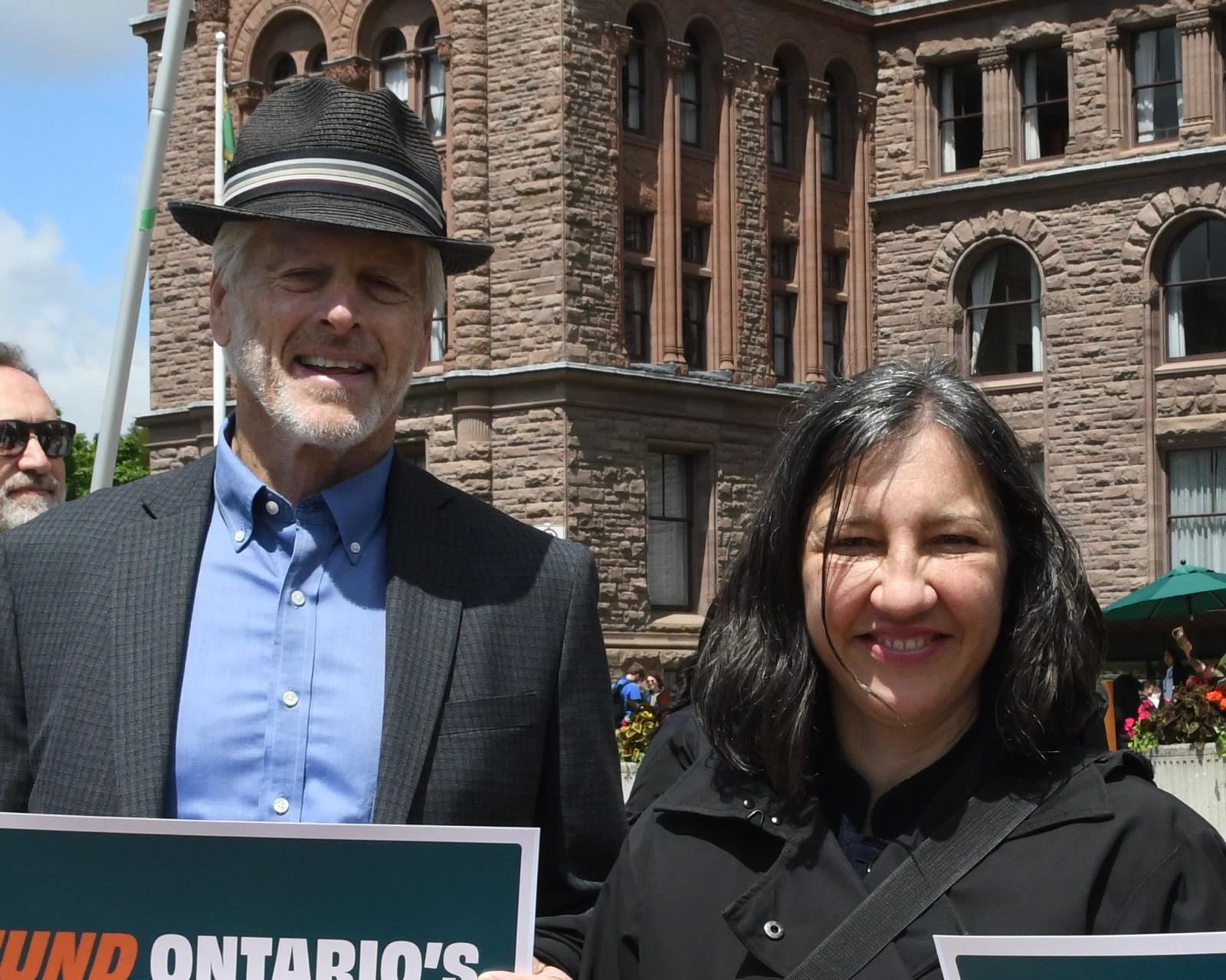
That’s why I’m joining MPP Chris Glover – Shadow Minister for Democratic Reform, for an in-depth panel discussion exploring one of the most pressing questions facing our province today: "Is Ontario still a democracy?"
As decisions about public lands, public services, and public funds increasingly happen behind closed doors, I’m increasingly concerned about transparency, accountability, and the erosion of our democracy in Ontario.
This event will bring together experts, advocates, and community leaders to unpack what’s happening, why it matters, and what Ontarians can do to protect our democratic institutions.
I hope to see you there, and have you as part of this vital discussion.
When: Monday December 8 at 7PM
Where: 252 Bloor St W, OISE – Room 2212
RSVP here.
What’s in the government’s new Buy Ontario bill?
After months of pressure, the Conservatives are finally moving toward a stronger Buy Ontario, Buy Canada procurement policy by giving themselves greater authority and enforcement power to require Ontario departments, municipalities, schools, hospitals and other publicly governed and funded organizations give preference to buying services and goods from Ontario and Canadian companies.
Ontario spends about $30 billion a year on procurement.With so many people looking for work, I am hopeful the government is looking at leveraging its buying power to give contracts to local businesses and protect and create lobs.
We will not know how far reaching this policy will be until the government publishes the proposed regulations.
Why are the Conservatives delaying important condo consumer protection rules?
No first-time homeowner wants the horror of turning the key to their front door for the first time and discovering they have bought a condominium that is far more expensive to maintain, smaller, and lacks the amenities they were promised at sale.
The consumer protection laws for condominium residents are so weak that this awful and expensive scenario can and is happening in Ontario.
On November 20, the Conservatives introduced proposed legislative changes in Bill 72 that kill and delay the rollout of important consumer protection laws that would protect condominium owners from being ripped off. We need these rules to be enacted, not killed.
Here are why these rules matter. When you live in a big condominium, the quality of your living hinges on how well the building is built, maintained, and governed.
When a building is poorly built by a developer who cuts corners and misleads buyers on costs, managed by an investor-heavy condominium board with no personal stake in the longevity of the building, and poorly maintained by an unlicensed property manager, big problems arise. It is the condominium resident who pays the price.
Currently, developers do not have to be fully honest or transparent about the cost of fees that condominium residents must pay to maintain their home and building. This lack of transparency is resulting in big fee hikes to condominium residents.
It has resulted in condominium residents buying a home and then discovering the maintenance fees are far higher than the builder said they would be, putting them at financial risk.
It has resulted in homeowners in smaller units paying more in maintenance fees than homeowners living in larger units because developers get complete discretion on deciding how much each resident pays in.
It has resulted in condominium residents receiving a nasty bill to cover a new maintenance expense because the builder did not set aside enough money in a reserve fund earmarked for maintenance.
For over a decade, there has been a movement of residents calling for stronger consumer protections. In 2015, the Ontario government introduced and passed laws to bring in stronger condominium protections, but ten years later, these sensible laws are still not in force.
We hear rumours the government is looking at overhauling the Condo Act. That’s why now is the time to call on them to strengthen the Condominium Act to protect condo owners and ensure they’re getting what they paid for. You can contact the Minister of Public and Business Service Delivery and Procurement directly in the button below.
A bad day for renters at Queen’s Park
On Monday, November 24, the Ford government pushed Bill 60, the Fighting Delays, Building Faster Act, through a final vote at Queen’s Park. They truncated debate in the legislature, refused to hold public hearings, and ignored more than 150,000 emails from people across Ontario.
When the vote happened in the legislature, people in the public gallery shouted “people over profits,” while the Premier heckled them, telling them to “go find a job.” And Ford didn’t stop there. Clearly rattled, he lashed out at “left-wing radicals” and “paid professional protesters,” and even floated the idea of targeted audits against groups opposing Bill 60 before quietly backing off days later.
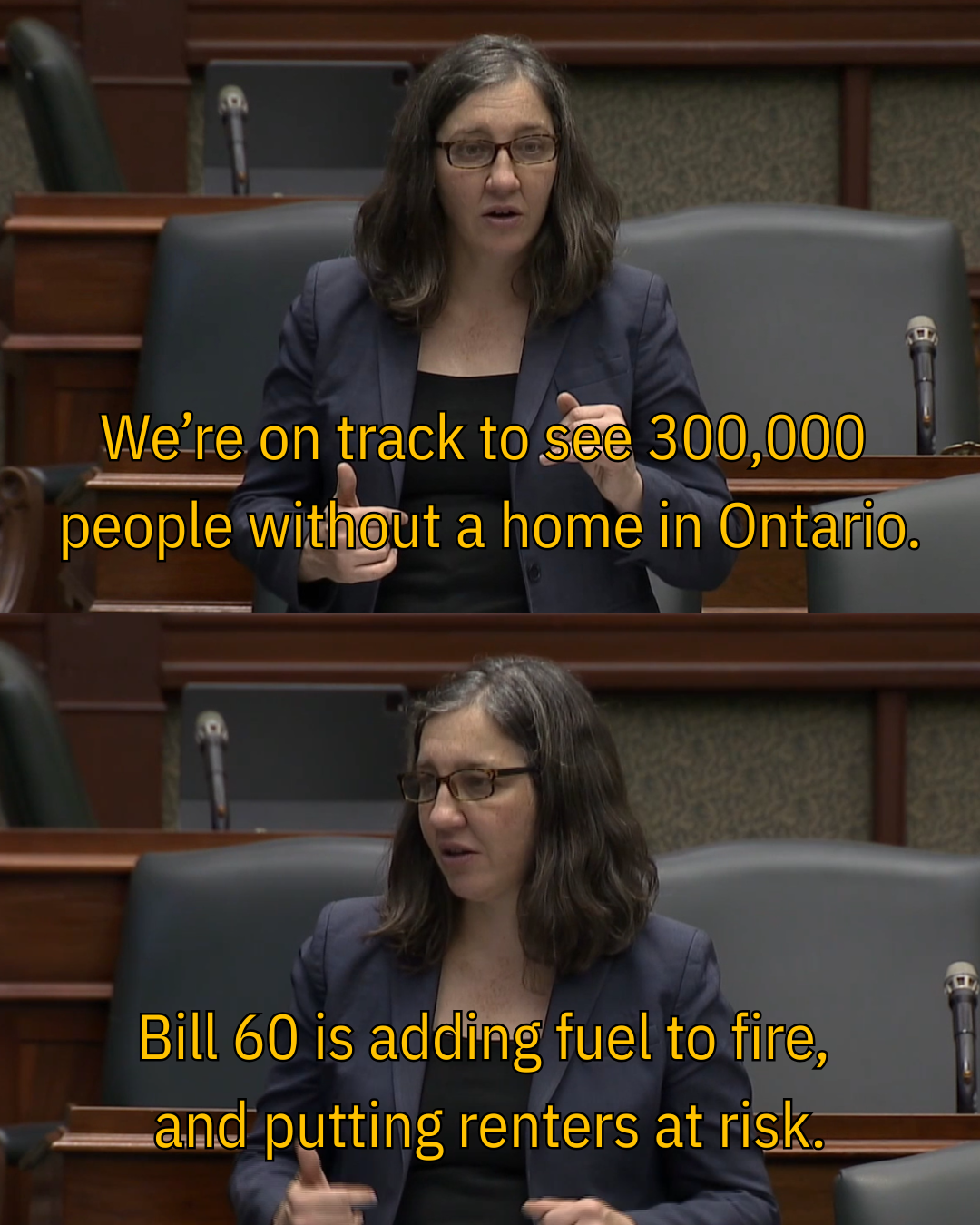
Bill 60 is now law. In Ontario, it is now easier for landlords to evict, and it’s harder for tenants to defend themselves at the Landlord and Tenant Board (LTB). The LTB is also being directed to establish a tenant blacklist by creating a searchable public LTB decision database.
Bill 60 also strips municipalities of their authority to develop green building standards, and bans municipalities from reducing any motor vehicle lanes for new bike lanes or other purposes to be set later by regulation.
The same day Bill 60 passed, we introduced an opposition motion calling on the government to repeal the law and to bring in real protections for renters, including fairness at the Landlord and Tenant Board, stronger rules against bad faith evictions, real rent control, and an end to above guideline rent hikes. The Conservatives voted that motion down.
This fight is not over. Renters deserve stability, safe homes, and real affordability. If you want to get involved, please reach out to my office at [email protected].
Ontario needs a real climate adaptation plan
On Thursday, November 27, my colleague MPP Peter Tabuns reintroduced the Ontario Climate Change Adaptation and Resilience Act, and I am proud to co-sponsor it.
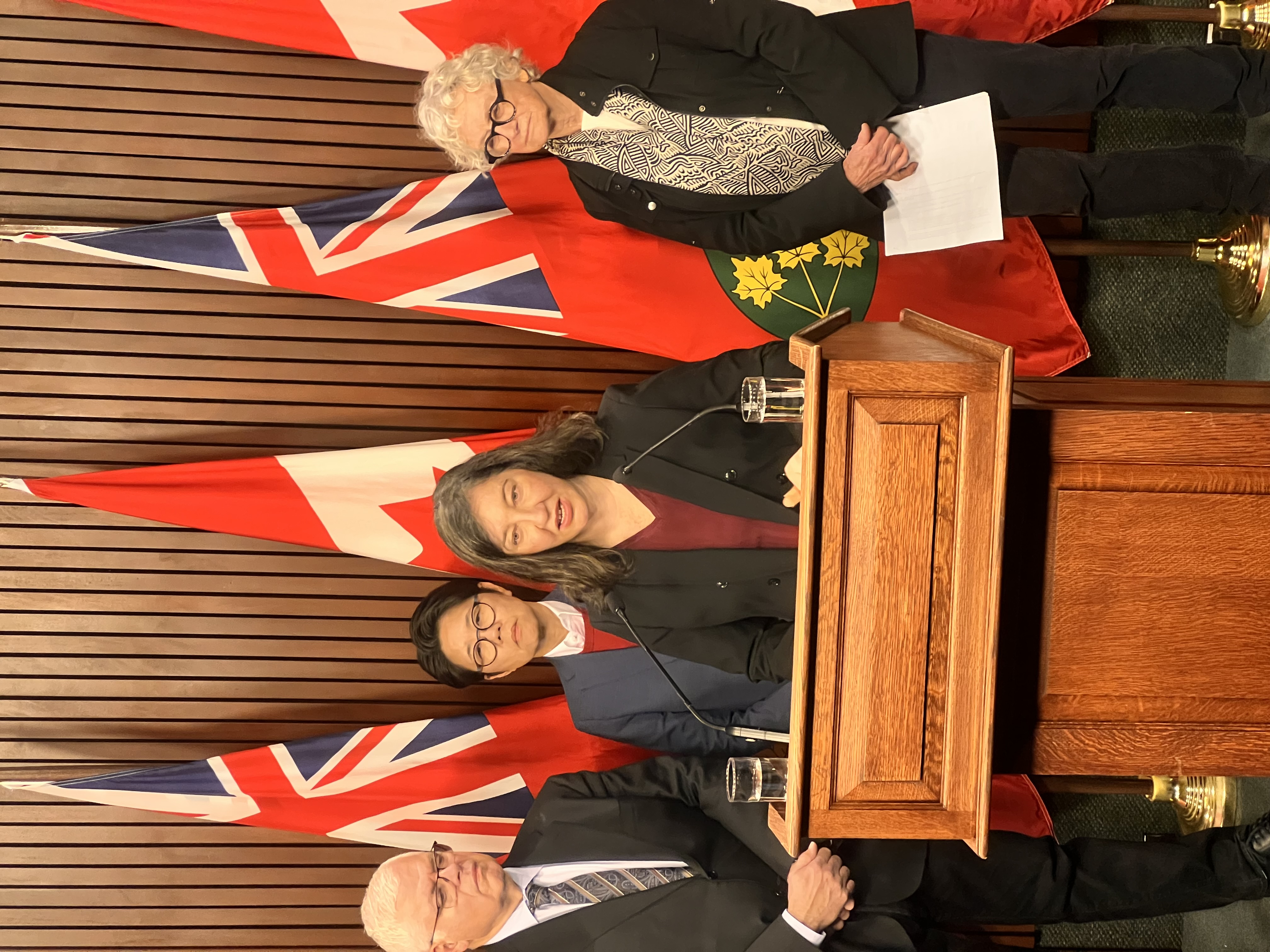
The climate crisis is here in Ontario. Wildfires have burned out of control for months, smoke has choked our cities and worsened asthma. Extreme heat days put seniors and renters without cooling at risk. Flooding overwhelms sewers, roads, and basements, costing us billions in damages. This is our reality, whether we like it or not.
Instead of preparing, the Ford government has chosen to pretend climate change doesn’t exist. The Auditor General reported the government has abandoned their climate plan, and the Fall Economic Statement went even further—removing any legal requirement to set greenhouse gas targets at all.
This bill would finally force the province to face its responsibilities by drawing on expert reports the government commissioned—and then ignored—and by creating the tools and funding needed to upgrade infrastructure, protect power, water, and communications systems, and strengthen emergency response so communities can withstand extreme weather.
Acting today will save lives and prevent costly damage tomorrow. When a storm is coming, you don’t ignore it—you prepare. The time to act is now, not when floodwaters are crashing through the front door.
Valuable home care program is cut
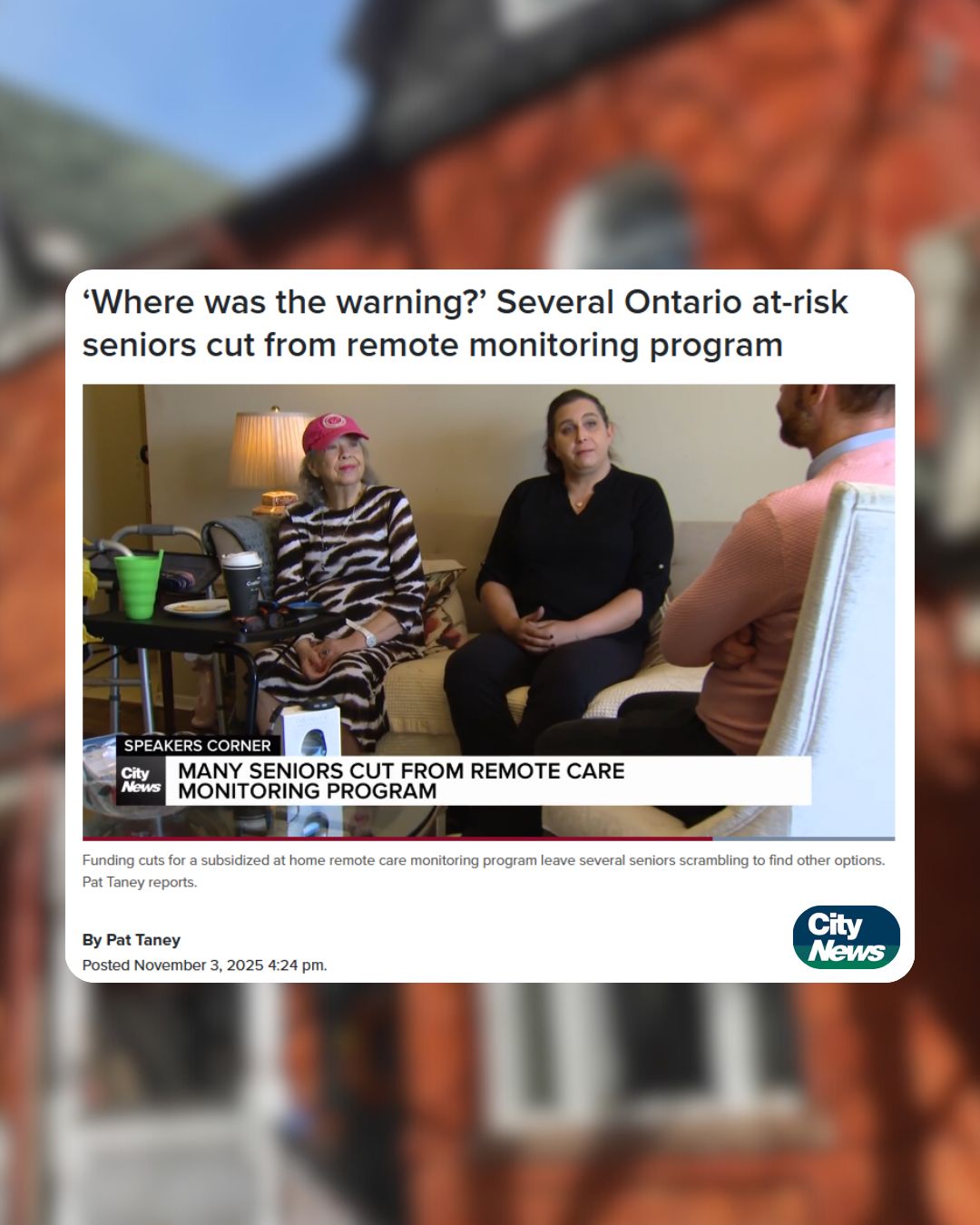
The Ministry of Health has slashed funding to Toronto Grace Hospital’s remote monitoring program by one-third, cutting thousands of seniors off from a service that helps them stay safe at home.
I first learned what that looks like from Margaret Gauthier, who I met at our recent Seniors Town Hall. On Tuesday, November 25, I shared her story in the legislature.
Margaret is 70, a Toronto renter, and she lives alone. About a year and a half ago, she was referred to the program and given a button she could press if she fell or needed help, so a health care professional could be sent to her home. “I always take it into the shower with me because I’ve had a few close calls. It’s scary,” she told us.
In September, Margaret fell while her alert button sat on the table beside her chair. Because of sciatica in her right leg, she couldn’t get back up. When she tried to press the button, it kept flashing “no connection.”
That’s how Margaret learned she was one of 18,000 people cut from the program. Now she pays $30 a month for a for-profit service—and even that device is malfunctioning.
Margaret wants to live safely at home. She doesn’t want to end up in hospital or long-term care, and neither do we—especially when those options cost more and take away independence. Seniors deserve reliable support to age at home with dignity and security.
I’ve written to the Minister of Health calling on her to restore funding to this program. I’m waiting for a response—and so are the 18,000 seniors who depended on it.
Enrolment to Heydon Park Secondary School has been stopped
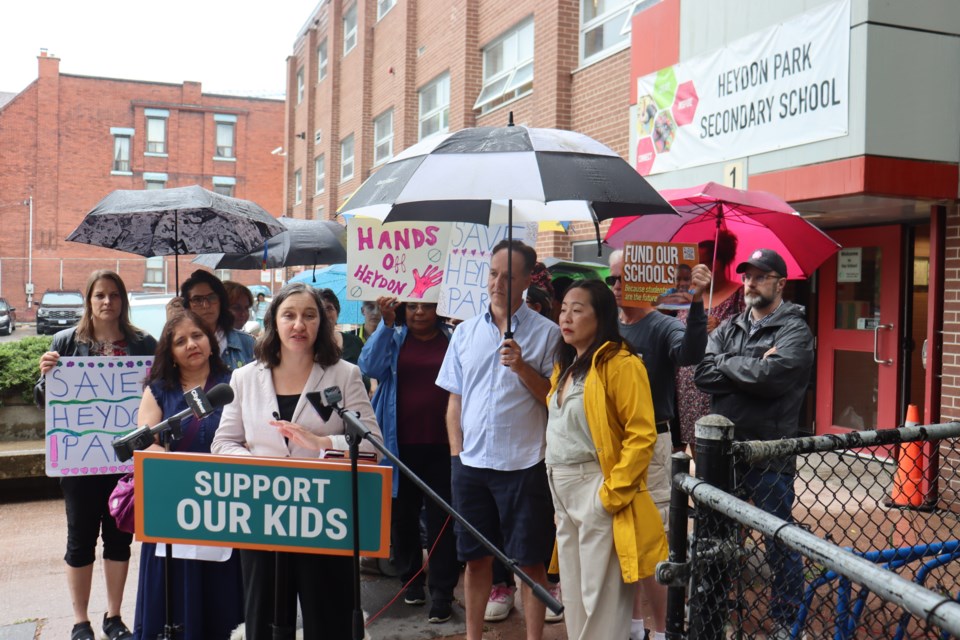
For months, parents, caregivers, and students in our community have been sounding the alarm that Heydon Park Secondary School is at risk of closure.
Heydon Park parents, students and teachers have been informed by the TDSB that enrolment for grade 9 and 10th grade has been paused. The school community has not been told by the TDSB what this means for the school and student learning. They are fearing the worst, demanding answers, and calling for the school to remain open.
What we know for certain, is that the threat to Heydon Park is driven by the Ministry of Education’s funding cuts to public education, especially special education.
When it comes to the future of public schools, Heydon Park is the canary in the coal mine. It will not be the last school threatened with closure.
Heydon Park is a unique, supportive high school for girls, trans and non-binary students with disabilities, as well as learning and mental health challenges. The school teaches students who have not been able to cope in a mainstream school.
My office has prepared a public sign-on letter to the Minister of Education Paul Calandra demanding Heydon Park remain open, and funding to public schools be restored. You can add your name by hitting the button below.
The Fall Economic Statement and Bill 68 become law
On Tuesday, November 25, the Ford government passed Bill 68, the Plan to Protect Ontario Act with limited debate, and no time at committee for the public to give testimony. This is highly unusual and undemocratic.
Here’s what you need to know about Bill 68 and the Fall Economic Statement:
- Dismantles Ontario’s climate action plan by removing the province’s requirement to set greenhouse-gas reduction targets.
- Scraps fixed election dates and raises the maximum political donation limit from $3,400 to $5,000, giving the government in power an unfair advantage on election day.
- Opening the door to more privatization in home care by reducing transparency to Ontario Health and Ontario Health at Home.
- Consolidating conservation authorities by creating a new Ontario Provincial Conservation Agency. This move will likely weaken the ability of conservation authorities to protect people from flooding and natural hazards.
- Health-care spending growth is being held to less than 1 percent, far below inflation and the needs of an aging population. This will mean more ER closures, longer wait times, burned-out staff, and declining quality of care.
- Education funding is less than inflation and school enrolment, which means schools and campuses will face even more cuts. Post-secondary education is facing over $1.4 billion in cuts which will mean class, department, and campus closures, along with staffing cuts.
Ontario is projected to build only 64,300 homes this year, the lowest in a decade. The Fall Economic Statement contained no plan to build affordable housing, reduce homelessness, or stabilize rent.
New jobs numbers show rising unemployment in youth, manufacturing
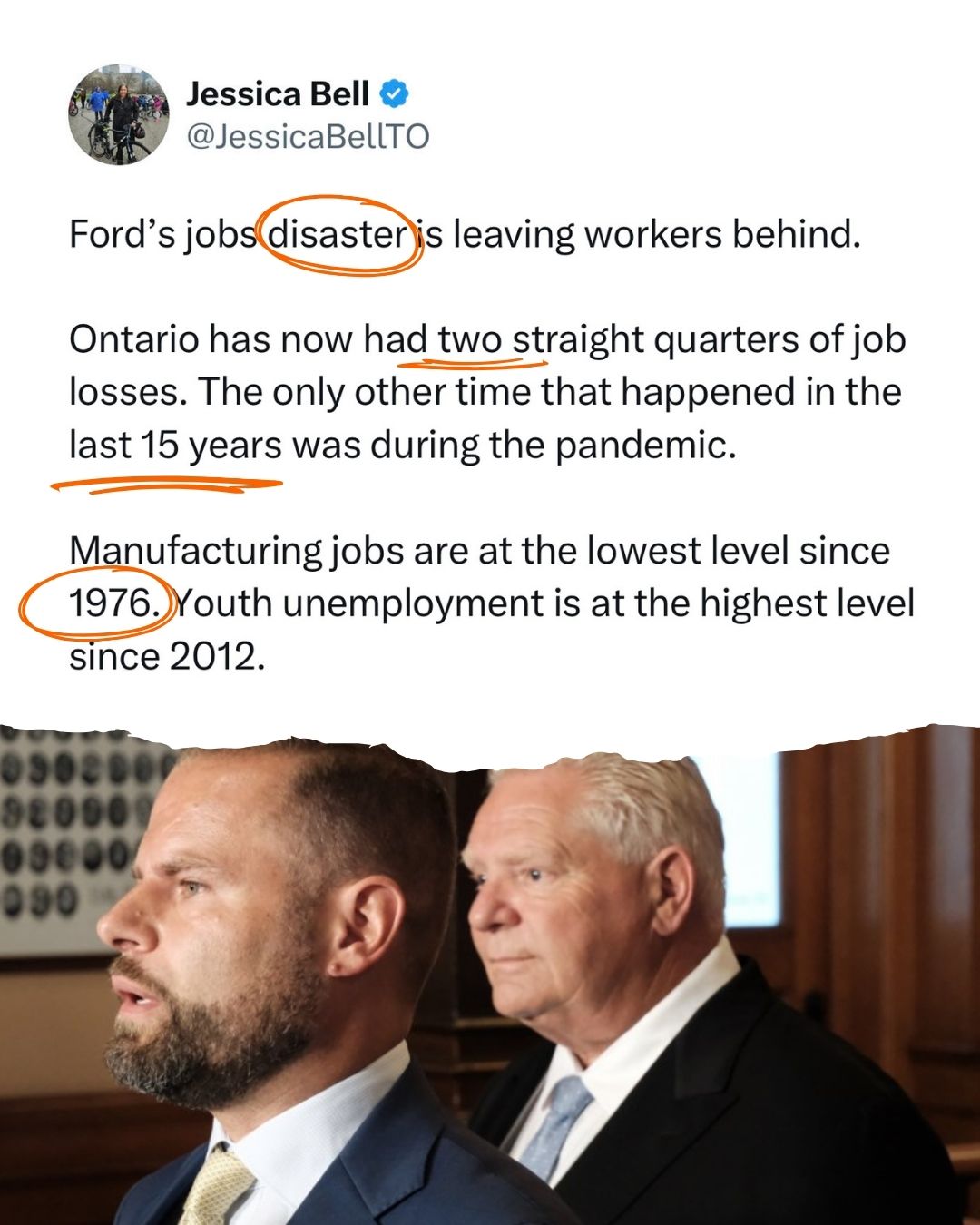
According to a new report from the Financial Accountability Office, Ontario has now seen two straight quarters of job losses. The FAO warns that long-term unemployment is rising to its highest share since the mid-1990s, outside of the pandemic.
Youth unemployment has climbed to 16.8 percent, leaving a generation of young people locked out of stable work.
Manufacturing is also shrinking fast. The FAO shows manufacturing has fallen in seven of the last eight quarters and is down nearly 10 percent since 2023. Manufacturing jobs now make up less than 10 percent of total employment for the first time since records began in 1976.
I am working with the Ontario NDP Leader’s Advisory Council on Tariff Response and Economic Security on a Made in Ontario Jobs Plan to prioritize public sector investment and good job creation opportunities in the public and private sector.