
Dear neighbour,
We returned to the legislature this week, and the top issue was the Conservative government’s use of the controversial Skills Development Fund.
The $2.5 billion skills training program doles out money to companies, municipalities, unions and non-profits to provide training to workers.
The controversy began when the Auditor General revealed that the Minister of Labour David Piccini and his political team were heavily involved in selecting projects to applicants ranked poorly by public servants, with high scoring ones being frozen out.
The Trillium news site also found that nearly two-thirds of the taxpayer-funded grants from the Ford government’s latest round of the Skills Development Fund went to organizations and companies that donated or publicly endorsed Conservative members in the last election.
Of the 246 groups that received grants, 137 were led by people who have donated over $1.3 million to PC Party causes. Eight of the ten largest grants went to PC donor-led groups.
Here are some examples of successful applicants. A firm with close ties to the former Labour Minister Monte McNaughton’s wife, got $2 million to help dentists sell their practices to private equity firms.
A non-profit owned by Zlatko Starkovski, the Ford’s family favorite nightclub owner, got over $6.5 million.
A church that hosted the Minister of Long Term Care Natalia Kusendova-Bashta’s wedding back in 2021 got $2.8 million.
We’re still hunting for information on what kind of training these applicants provided, to who, and how successful the training was in helping unemployed workers find jobs.
What we know for sure is that this Skills Development Fund is happening at the same time as public colleges are being starved of funding and are laying off thousands of workers. Public colleges are designed to provide affordable education on specialities ranging from hospitality and public relations to careers in the trades.
The Conservatives are replacing public education with private training delivered in many cases by their well-connected friends.
This whole scheme looks rotten to the core.
All opposition parties are calling on Minister Piccini to resign, and for the Ontario government to clean up its act and help workers, not their political friends.
Sincerely,
Jessica Bell
MPP, University-Rosedale
n this newsletter:
- We introduce our Buy Ontario First strategy
- Financial watchdog report shows health care, education cuts are coming
- Hearings on the government’s flawed opioid strategy will begin Monday
- Are the Conservatives looking at getting rid of fixed tenancies?
- Bill 56: Clean Water Act revisions and the end of speed cameras
- Bill 33 gives government power to take over school boards, hamstring student unions
- NDP calls on Ford to put fans first and end ticket resale price gouging
- Queen’s Park North: Give your feedback November 4
- Raising the alarm - Microplastics in the Don River
- KBCLS Free Online Legal Workshop for Tenants October 29
- It’s time to ban Above Guideline Rent Increases
We introduce our Buy Ontario First strategy
This week, the Ontario NDP introduced our Buy Ontario First strategy — a procurement plan to prioritize Ontario and Canadian businesses in public spending contracts issued by the Ontario government, and other provincially-controlled institutions, as well as ban U.S. companies from receiving public contracts until the trade war is over.
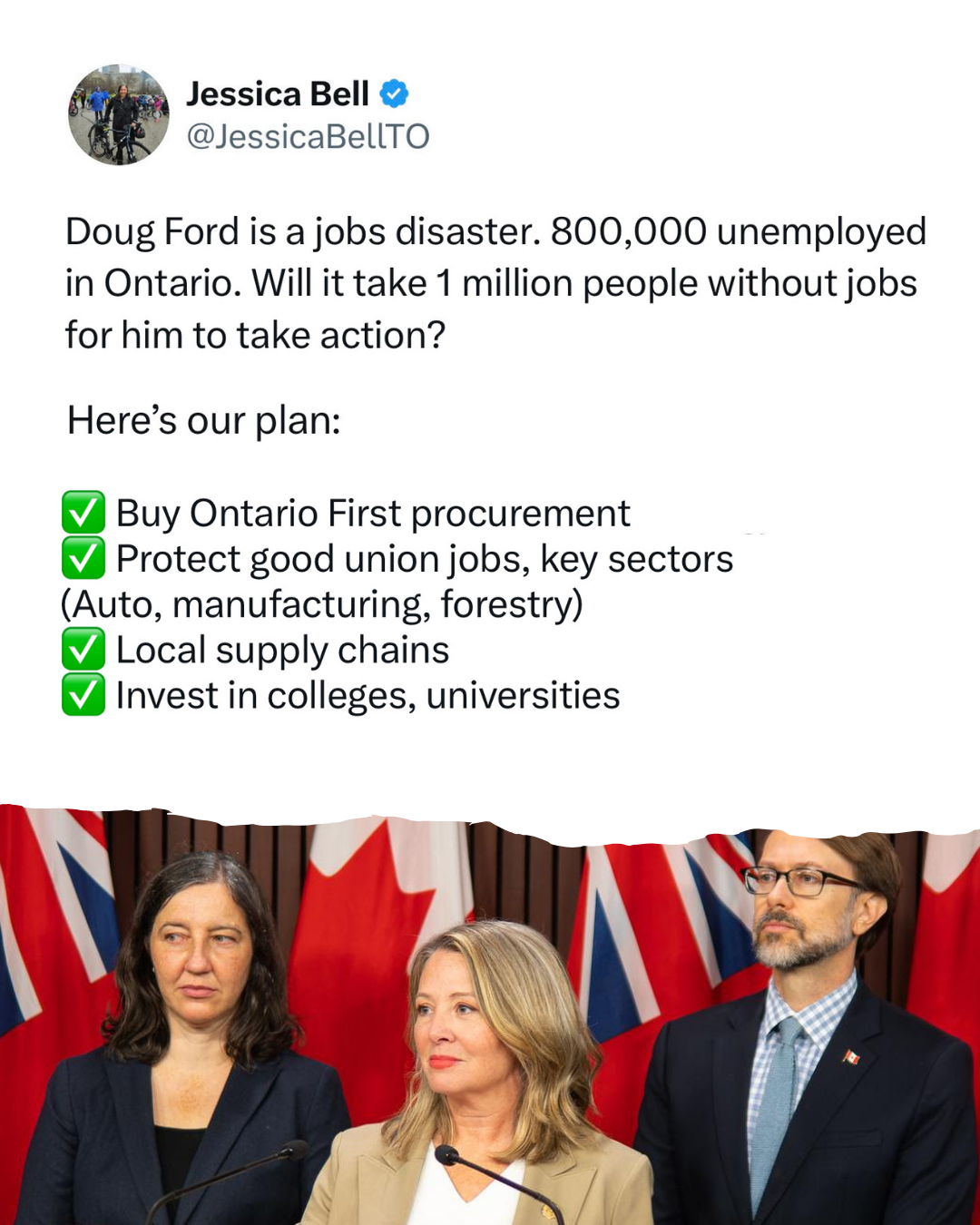
Government procurement is a practical way for Ontario to leverage the $30 billion it spends on services and infrastructure to support local businesses and create and protect jobs.
The Conservative government’s Buy Ontario policy is too weak to be effective. Municipalities aren’t covered. U.S. firms with 250 or more Canadian employees can apply for contracts. Companies with existing supply contracts are exempt from these new rules, meaning that if a U.S.-controlled company already has a contract in place to provide goods or service, it can continue doing so. That’s why we hear in the news about a U.S. company getting a $140 million contract to build and install windows on a Mississauga hospital.
Our Ontario First motion will close those loopholes and require Ontario and Canadian companies to get first consideration for public contracts — creating jobs, training opportunities, and long-term economic growth here in Ontario. Other provinces like Quebec and Manitoba already do this. It’s time for Ontario to do it too.
Our motion will be going to a vote in the next two weeks. If you’d like to share your feedback or work with us to pressure the government to strengthen its Buy Ontario policies then please contact us at [email protected].
Financial watchdog report shows health care, education cuts are coming
On Thursday, the Financial Accountability Office of Ontario released a bombshell report that gave us a grim snapshot of Ontario’s future.
The report confirms that the Ford government’s 2025 budget does not allocate sufficient funding to maintain current service levels in health care, education, long-term care, colleges, and universities.

If you think services in Ontario are bad today, this finance watchdog report is sounding the alarm: the Conservatives are looking at making it a whole lot worse.
Health care spending growth will be slashed to less than 1%, far lower than inflation and the increased demand we're facing as our population ages. This funding plan is a recipe for emergency room closures, longer wait times for surgeries, burned-out staff, and declining health care quality.
When it comes to health care, Ontarians are getting a raw deal compared to residents in other provinces. We are second to last compared to all the provinces when it comes to health care funding, and we are dead last when it comes to funding for hospitals.
The education budget will only grow at a lower rate than inflation, which simply isn't enough to keep up with the growing numbers of kids in schools, and those who need a school place.
Parents should be furious. I am.
You can read more about what the government has in store for our services right here.
We expect the Fall Economic Statement – Ontario’s mini budget – to be released on November 6th. We’ll be raising these issues and calling for Ontario to invest wisely in the services that benefit everyone and our economy.
Hearings on the government’s flawed opioid strategy will begin Monday
On Monday, October 27, the Standing Committee on Public Accounts will begin hearings on the Ontario Auditor General’s 2024 report, Implementation and Oversight of Ontario’s Opioid Strategy. The hearings will take place at 1:45pm in Committee Room 151 at Queen’s Park, 111 Wellesley Street West. More info here.
During these hearings, MPPs will question senior public servants about the government’s response to the opioid crisis. While only MPPs can ask questions, the session is open to the public, and you are welcome to attend.
The Auditor General found that Ontario’s opioid response is not effective in meeting the challenging nature of the opioid crisis in Ontario.
Leadership within the Ministry of Health is unclear, coordination between agencies is weak, and major policy changes, such as closing supervised consumption sites and creating new HART Hubs, were made without adequate evidence.
The Auditor General recommendations to the government include:
- a new holistic strategy using best-practices for addressing addiction
- increase the number of primary care providers and hospitals who can provide medication and addiction treatment
- increase access to clinics that can quickly provide addiction services without referral or appointment
- improve oversight to ensure that doctors and pharmacies are not overbilling or taking advantage of programs to provide medication and Naloxone kits, and
- have health experts assess whether providing a safe supply of opioids is an appropriate way forward.
Once the hearings conclude, members of the Public Accounts Committee will work with the Auditor General to push for full implementation of the report’s recommendations and develop additional proposals to strengthen Ontario’s response to the opioid crisis.
You can read the full report here. If you have questions or would like to attend the hearing contact our office by hitting the button below.
Are the Conservatives looking at getting rid of fixed tenancies?

On Thursday, the government introduced Bill 60, the Fighting Delays, Building Faster Act, a massive omnibus bill with more than 40 changes to various regulations and acts. Among other things, it would scrap Toronto’s green roof policy and give the Minister of Transportation the power to block dedicated bus lanes on residential streets and ban the conversion of vehicle lanes into protected bike lanes.
We’re still reviewing the bill, but some of the most concerning parts deal with housing. The bill proposes major changes to the Residential Tenancies Act that would make it easier for landlords to evict tenants and harder for renters to defend their homes.
As part of the rollout, the government announced that it will begin consultations to explore changes to lease agreement expiry to give landlords more control on who occupies their units and for how long. Right now, most tenants sign a fixed-term lease that automatically becomes month-to-month when it ends. Changing these rules could end rent control as we know it, opening the door to more evictions and higher rents across the province.
The bill would also make several other major changes. Tenants who want to raise maintenance or repair issues at an eviction hearing would have to pay half of the rent arrears the landlord claims before their case can be heard. This would make it harder for many tenants to challenge bad landlords or unsafe conditions.
Other changes include cutting the grace period for unpaid rent from 14 days to seven, reducing the appeal window from 30 days to 15, and removing the requirement for landlords to pay compensation when reclaiming a unit for personal use if they give 120 days’ notice.
This bill is really bad for tenants.This will not fix the housing crisis—it will make it worse. We’ll be organizing and pushing back hard against these changes, and I hope you will join us. Renters deserve stability, not attacks on their rights.
If you are worried about how these changes could impact you, I want to hear from you. Please reach out to my office at [email protected] or 416 536 7206.
What’s in Bill 56: Clean Water Act revisions and the end of speed cameras
This week, the government introduced Bill 56, the Building a More Competitive Economy Act, and moved it directly to second reading and debate in the Legislature. The omnibus bill makes wide-ranging changes across environmental protection, transportation, labour, and health regulation. While the government says it’s about “cutting red tape,” it hands more power to Ministers and weakens safeguards that keep Ontario’s water clean, forests protected, and streets safe.
Bill 56 gives the Environment Minister new powers to rewrite and approve local drinking-water protection plans, rules created after the Walkerton tragedy to keep contamination out of our water. Local committees would lose their say on what’s included, and plan changes would be automatically approved after 120 days, even without review. Groups like Environmental Defence and the Ontario Headwaters Institute have warned that rolling back Ontario’s drinking-water safeguards could undo 25 years of “source-to-tap” protection.
Under the Highway Traffic Act, Bill 56 effectively bans the use of municipal automated speed safety cameras in school zones. Instead, the legislation gives the Minister power to order municipalities to install signs near schools as a replacement.
Municipalities, police, and road safety advocates including the Ontario Association of Chiefs of Police and the Association of Municipalities of Ontario, have all said this will make streets less safe for children and seniors.
Municipalities will also be encouraged to use speed bumps, raised crosswalks, and roundabouts instead. Premier Ford said the province will create a new fund to help cover some of those costs, though he could not say how much funding will be available.
Changes to the Crown Forest Sustainability Act remove annual harvest approvals and let companies submit one logging plan covering multiple areas. Updates to the Species Conservation Act also weaken oversight of species-at-risk protection. Environmental groups warn this will erode transparency and make it easier for industry to bypass safeguards.
Bill 56 is now being debated at Queen’s Park. If you have feedback on the legislation, please reach out to my office by hitting the button below.
Bill 33 gives government power to take over school boards, hamstring student unions
On Tuesday, October 28, the government is expected to bring Bill 33, the Supporting Children and Students Act, back for debate at Queen’s Park.
The bill would give the Education Minister broad the power to take over school boards, give the minister power to sell off school land, and permit police officers in schools.
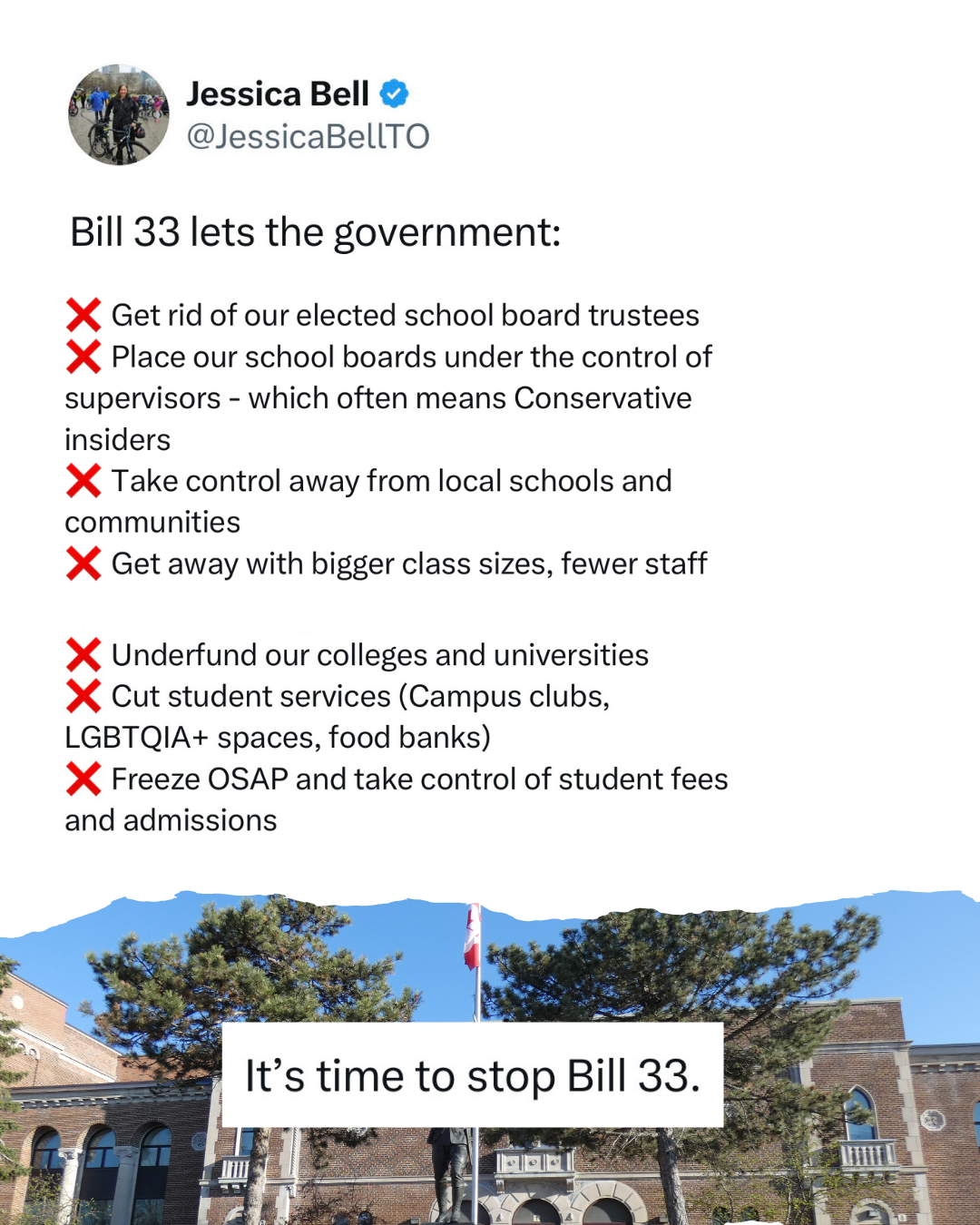
The bill also resuscitates the controversial Student Choice Initiative by giving the government regulation-making power over how student unions collect student fees, allowing the Minister to decide which fees are mandatory or optional.
Changing how student fees are collected will likely reduce the amount of money student unions can collect for their union and the services they run, such as campus radio, newspapers, environmental groups, legal clinics, and more. It will also create financial uncertainty because funding will change year by year.
This bill doesn’t address the significant underfunding of our schools, colleges and universities, which is the primary reason why schools are struggling and Ontario’s tuition rates are the highest in the country.
The legislature will be debating this bill next week. If you have feedback on Bill 33, I want to hear from you. Please email me at [email protected].
NDP calls on Ford to put fans first and end ticket resale price gouging
It’s an exciting moment for Toronto, with the Blue Jays back in the World Series for the first time in over 30 years. But while fans across Ontario are eager to cheer them on, many are finding that tickets are being resold online for thousands of dollars, far beyond what most people can afford.
That’s why my colleague Shadow Attorney General Kristyn Wong-Tam has re-tabled their motion calling on the government to update the Ticket Sales Act and ban ticket resale above face value. The goal is simple. Stop predatory resellers and bots from gouging fans and to make sure ordinary Ontarians can afford to see their team play.
Blue Jays fans shouldn’t have to go into debt to support their team. The government could fix this today by supporting the NDP’s motion to put fans first and make resale above face value illegal.
Let’s make sure the next generation of fans can actually afford to be in the stands. Take action for fair ticket prices in the button below.
Queen’s Park North: Give your feedback this November 4
Join the conversation around Queen’s Park North, and a potential revamp coming its way. This November 4, you can attend a community workshop hosted by the City of Toronto to learn about and share feedback on the emerging design ideas and approaches for the proposed changes so far. The ideas being presented at this session have been informed by community feedback received during the first engagement phase, which took place during the summer.
As the City moves to the second engagement stage, you can use your voice and your vision to contribute to this project, taking place right at the heart of our city.
When: Tuesday November 4 at 6:30PM
Where: Metro Central YMCA- Auditorium, 20 Grosvenor St
RSVP: Hit the button below.
KBCLS Free Online Workshop for Tenants: Understanding the T1 Tenant Application
On Wednesday, October 29th at 2.30pm, the Kensington Bellwoods Community Legal Services is hosting a free online legal workshop to learn about the T1 Application for tenants to claim money from landlords for illegal rent, charges, or deposit issues.
This workshop is presented by Shamsa Sajwani, who is currently pursuing her Paralegal Licensing education at Seneca Polytechnic. With a strong foundation in legal studies, Shamsa is passionate about access to justice and committed to building a career that bridges legal knowledge with practical advocacy.
Please register here to receive the zoom link. After registering, you will receive a confirmation email containing information about joining the meeting.
Raising the alarm - Microplastics in the Don River
A new University of Toronto study has found that 522 billion microplastic particles–roughly the weight of 18 cars–flow through Toronto’s Don River into Lake Ontario every year. This shocking amount of plastic pollution far exceeds levels found in similar urban waterways across North America.
About 40 percent of the larger plastic items detected in the river were plastic bags and wet wipes. Researchers also found that heavy rainfall dramatically increases the amount of plastic being flushed into Lake Ontario, with storm flows accounting for nearly half of the year’s total pollution.
This research paints a clear picture of how much plastic pollution is reaching our lakes and drinking water systems. Ontario needs a comprehensive plan to reduce single-use plastics, prevent stormwater runoff, and clean up our rivers before more damage is done.
One practical step forward is the Environmental Protection Amendment Act, a bill I introduced in 2021 and reintroduced in 2023, which would require washing machines sold in Ontario to include filters that capture microfibres before they reach our water systems. But that’s just one part of the solution. We’ll keep working with researchers, environmental organizations, and communities to push for stronger protections for Ontario’s waterways.
If you’d like to learn more or share your ideas, reach out to my office at [email protected] or 416 535 7206
It’s time to ban Above Guideline Rent Increases
Across our province, renters are stressed and worried about their housing. They’re facing huge rent hikes at a time when rent is already at record highs. People tell me they’re scared. If they get priced out, there’s nowhere to go.
The Conservatives have had seven years to fix the housing crisis, and they’ve failed. It’s never been more expensive to rent or buy a home. And instead of reining in corporate greed, this government keeps letting big landlords make things worse.
Right now, Canada’s biggest and most profitable landlords are using Above Guideline Rent Increases (AGIs) to push rents far beyond the provincial limit of 2.5% for 2025. They’re filing hundreds of applications every year, often for routine maintenance that should already be covered by rent: fixing elevators, replacing balconies, landscaping. These increases can add up to $35,000 over the lifetime of a lease, draining money from renters and fuelling record profits for developers and investors.
That’s why last week, I joined my colleague Shadow Minister for Housing MPP Catherine McKenney and renter groups like the Federation of Metro Tenants’ Associations and Ontario Renters for Fair Housing to say loud and clear: it’s time to ban AGIs.
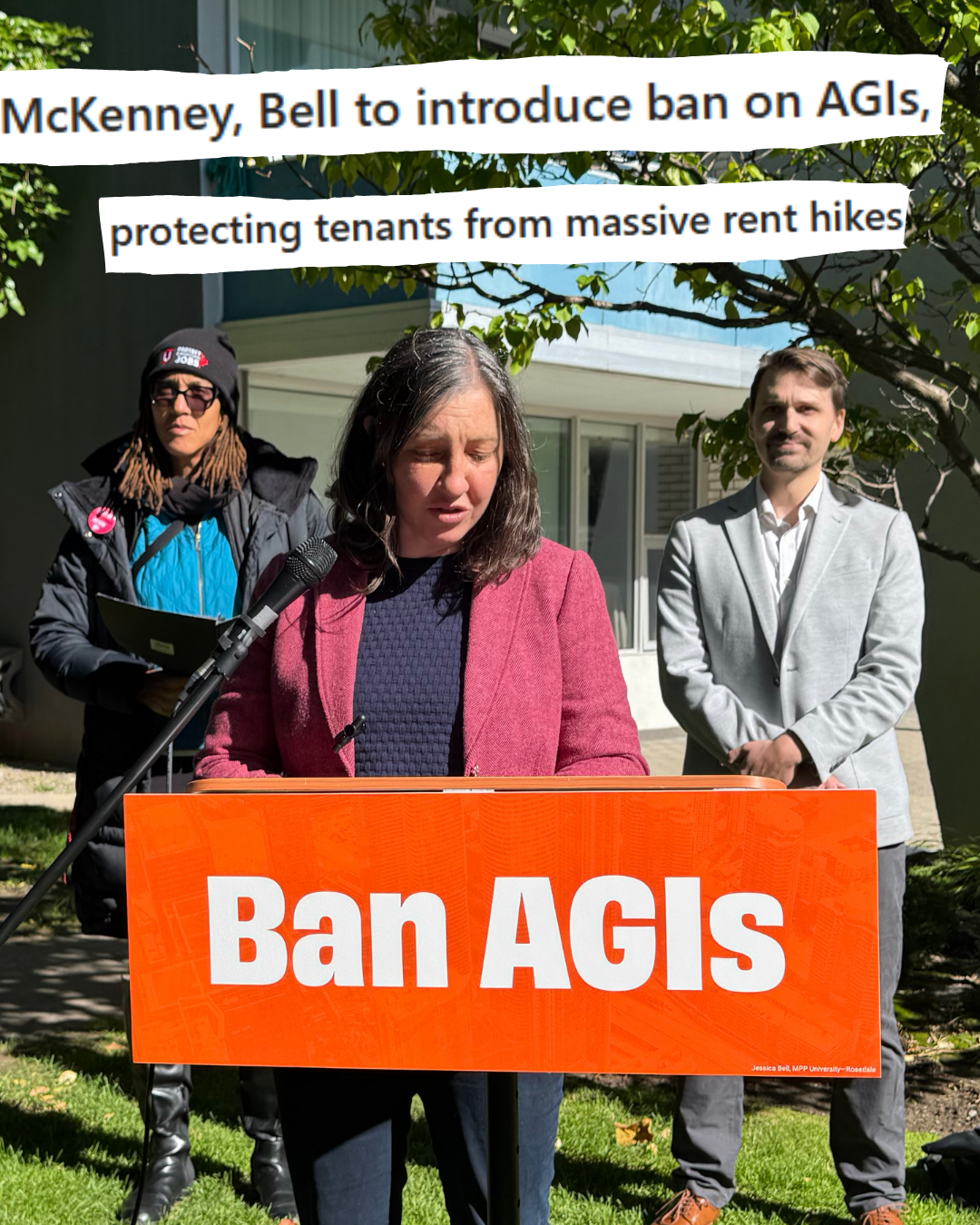
This fall, we’ll be introducing a motion at Queen’s Park to ban Above Guideline Rent Increases for large corporate landlords. Renters deserve homes they can afford, that are safe, well-maintained, and free from constant financial pressure.
If you’ve been hit by an AGI or want to share your story, please reach out to my office.